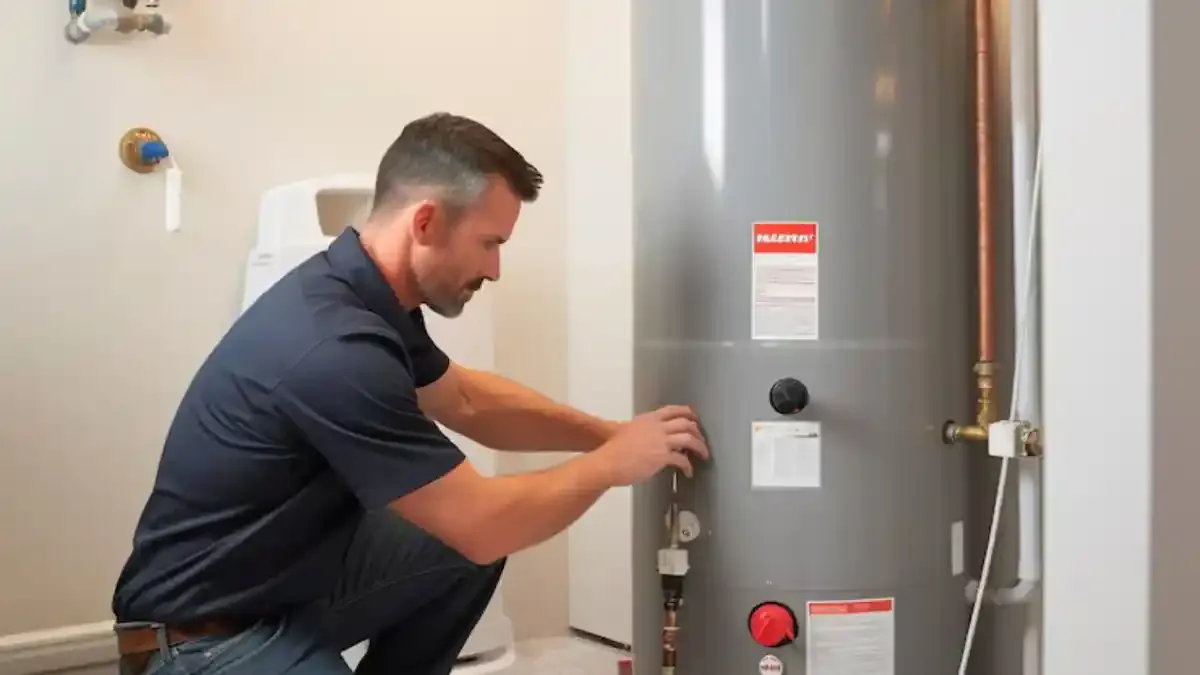
Repair or replace: how the decision actually gets made.
Water heater replacement is the removal of a failed or failing tank and the installation of a new one, with the gas or electric hookup, relief valve, water connections and earthquake strapping redone. It is the right call in a few clear situations, and the wrong one in others.
Replace when the tank body leaks, because no patch holds on a corroded steel shell. Replace when the unit is old and needs a major part. Repair when the heater is mid-life and the fault is a thermostat, element or thermocouple. Our water heater repair page covers the fixes that are worth making.
Emergency: the tank is leaking or has split open.
A heater that is pouring water is an active leak. Close the cold supply valve above the tank by turning it clockwise. If it is a gas unit, turn the gas control knob to off. For an electric unit, switch off the breaker only if you can reach the panel without standing in water.
Smell gas? Leave the building at once and call SoCalGas at 1-800-427-2200 from a safe place. Call 911 if anyone may be in danger. Do not go back in to find the shutoff.
Same-day replacement is often possible. Dispatch runs 24/7, so a failed tank at midnight can still be scheduled the same way as a daytime call.
Signs the tank is at the end.
Signs a replacement is due.
- Water seeping from the seams or the bottom of the tank.
- Rust-colored hot water that does not clear after flushing.
- Repeated element, thermostat or thermocouple failures.
- Loud rumbling or popping from sediment baked onto the tank floor.
- Corroded fittings and a heavily rusted tank base.
- A heater so old the data plate date is hard to find.
- Less hot water than the unit used to deliver.
What hard water does to a tank in Claremont.
Golden State Water Company serves Claremont with a mix of treated groundwater and imported water. Its 2026 water quality report, covering 2025 data, lists hardness from 97 to 330 mg/L with a 190 mg/L average, or about 5.7 to 19 grains per gallon and an average of 11.
At that level scale builds on the tank floor and insulates the burner or elements from the water. The heater works harder for the same hot water. If you are buying a new tank, a water softener and filtration system is the lever that protects it.
California rules for the new tank.
California Health and Safety Code section 19211 requires new and replacement water heaters to be braced, anchored or strapped so they resist falling or shifting in an earthquake. This covers heaters up to 120 gallons that have a pre-engineered strapping kit available.
In practice that usually means two metal straps, one near the top and one near the bottom of the tank, anchored into wall framing. A plumber doing a replacement should include it. For permit questions on your specific job, ask the Claremont Building Division at (909) 399-5477.
Failed heater? Get a plumber moving.
Call and a dispatcher will arrange licensed replacement, strapping and removal of the old tank.
Choosing the replacement.
| Option. | Best for. | Trade-off. |
|---|---|---|
| Standard gas tank. | Homes already piped for gas, the usual like-for-like swap. | Standby heat loss, and the flue must be sound. |
| Standard electric tank. | Homes without gas service. | Slower recovery, higher running cost in many homes. |
| Larger tank. | Big households with long showers and a tub. | More floor space and more standby loss. |
| Tankless unit. | Endless hot water and a smaller footprint. | Higher install cost and annual descaling, see tankless water heater. |
Like-for-like is fastest because the gas line, vent and water connections already fit. Changing fuel type or going tankless means extra work on gas piping, venting or electrical, and is better planned than rushed during an emergency.
What the replacement visit looks like.
From call to hot water.
- 1.
Call dispatch.
Tell us the heater type, fuel, capacity if you know it, and where it sits.
- 2.
Shutoff and drain.
The plumber isolates water and gas or power, then drains the old tank to a safe point.
- 3.
Disconnect and haul.
Connections come off, and the old tank is removed from the property.
- 4.
Set the new heater.
A new tank goes in with fresh flex connectors, a relief valve and discharge line, and an expansion tank where the system calls for it.
- 5.
Strap and test.
Earthquake straps go on, gas joints are leak-tested, and the unit is fired through a full cycle.
What moves the price of a replacement.
Replacement price factors.
The number depends on the tank you pick and the condition of what is around it. You get a clear price before work starts.
Tank size and fuel.
A larger gas tank and a standard electric unit are priced differently.
Condition of the old hookups.
Corroded shutoffs, supply lines or a failed vent connection add parts and labor.
Code items.
Strapping, a relief valve discharge line or an expansion tank may be needed.
Location.
Garage floor, closet and attic installs differ in access and lifting.
Timing.
A planned daytime swap and an after-hours emergency install follow different schedules.
We cannot put a figure on it without knowing the unit, the access and the existing piping. The plumber gives the full price on site before touching anything.
Before the plumber arrives.
What to do before the new heater goes in.
Stop the water.
Close the cold supply valve and, if you can do it safely, turn the heater's gas control to off.
Clear a path.
Move stored items so the plumber can walk the old tank out and bring the new one in.
Read the label.
Note the capacity and fuel type from the data plate so the right tank is brought.
Mop and ventilate.
Remove standing water and open a door or window if the room is closed.
Why replacement is often the cheaper long-term choice.
A tank that has already leaked from the body cannot be patched, and pouring money into thermostats on a corroded shell tends to end in a second emergency call. If your heater is old and has failed once, replacing it on your schedule beats replacing it during a flood.
For planned work with time to compare sizes, see water heater installation. We also dispatch to Pomona.
Strapping law and permits.
California Health and Safety Code section 19211 requires water heaters to be braced, anchored or strapped against earthquake movement, at minimum per the California Plumbing Code (built on the Uniform Plumbing Code, UPC). Ask the Claremont Building Division at (909) 399-5477 about permits.
Water heater replacement questions.
.
Yes. Dispatch is available 24/7, and a licensed plumber is sent when a tank has failed or is leaking. Same-day replacement is often possible, depending on the unit and parts, and you hear a clear price before work starts.
.
Condensation beads on the outside and dries up. A leak keeps coming back, often under the tank or from the base, and may be rust-stained. A plumber can trace whether the leak is a fitting you can repair or the tank body, which means replacement.
.
Yes. Health and Safety Code 19211 requires new and replacement residential water heaters to be braced, anchored or strapped against earthquake movement, for units up to 120 gallons with a kit available. Strapping is part of a proper install, not an add-on to skip.
.
It is possible but usually better planned. Tankless often needs larger gas supply, new venting or electrical work. Many people put a tank in now and read about the tankless option once hot water is back.
.
Yes. Removal and haul-away of the old tank is part of a standard replacement visit, so you are not left with a drained tank in the garage.
.
It can. Claremont's reported hardness averages about 11 grains per gallon, and scale on the tank floor makes heaters work harder. Regular flushing helps, and a softener reduces the scale in the first place.
.
Leave right away and call SoCalGas at 1-800-427-2200 from a safe location. Call 911 if life may be in danger. Do not light anything or flip switches. A plumber can work once the gas company has cleared the home.