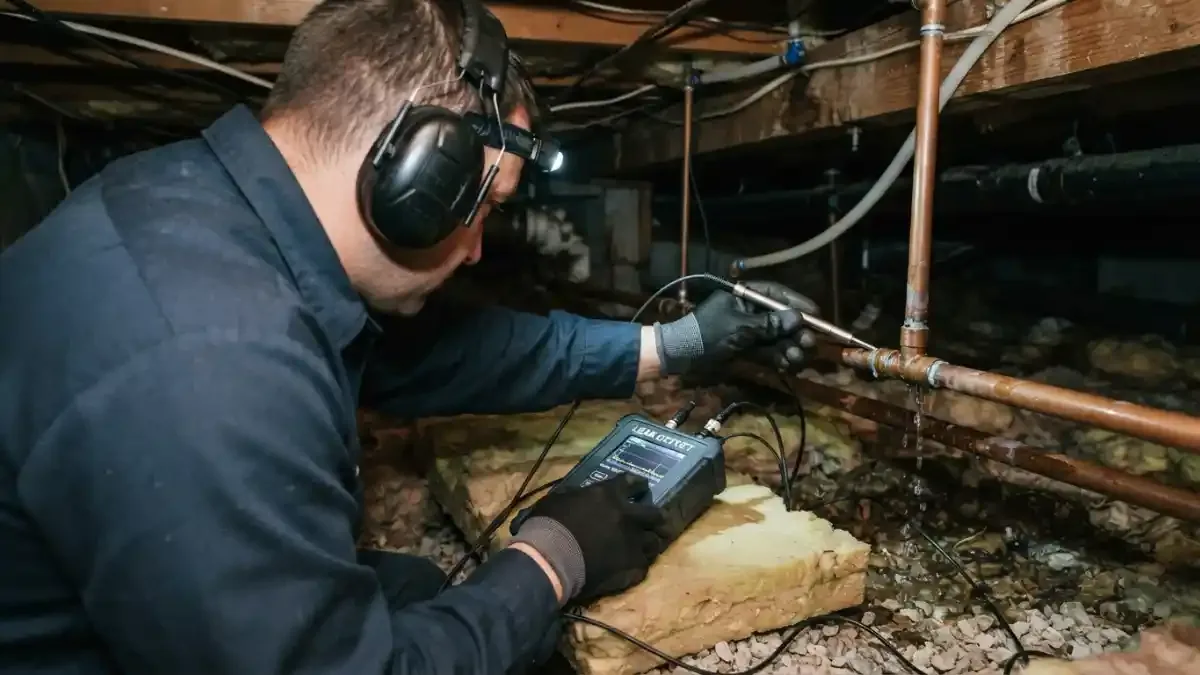
Leak detection is the work of locating a water leak you cannot see, then proving where the pipe is failing before anyone cuts into a wall, a slab or a yard. In Claremont it usually starts with a symptom, not a diagnosis. The meter creeps while the house is quiet. A ceiling stain spreads. The hallway floor feels warm.
Water service line problems and low water pressure are handled on this page too, since both so often trace to a leak between the meter and the house. The diagnosis is the same, so call and dispatch will sort out which it is.
Meter still running or a high water bill.
Start with the meter, because it settles the question fast. Golden State Water Company's own guidance is simple: turn off every tap and appliance inside and outside, then watch the meter needle. If it keeps moving, there is probably a leak on the property. Many meters also have a small low-flow dial that spins on very slow leaks.
Who pays matters. The utility maintains its lines up to the meter. Everything past it, including the service line and every pipe in the house, belongs to the owner. GSWC names irrigation problems and leaks as the two most common causes of a high bill.
Now shut the main valve at the house and check again. Needle stops? The leak is inside. Needle still moving? It is in the line between meter and house, usually underground. That one test halves the search before we arrive.
Signs water is escaping where you cannot see it.
- The meter needle or low-flow dial moves with every fixture shut off.
- A bill far above your usual months with no change in habits.
- Hissing or running sounds in the walls at night.
- A warm patch on the floor that never cools.
- Musty smell, peeling paint or bubbling drywall.
- A soggy strip of lawn or damp soil with no rain.
- Pressure that drops for no clear reason.
Stains on a ceiling or wall.
A brown ring on a ceiling is old news by the time you see it. The water has already soaked insulation and drywall above. The source may be a supply line, a drain joint, a shower pan or a roof leak that only looks like plumbing.
We start with a moisture meter and a thermal camera. Cold, wet drywall shows as a clean shape, and the pattern points uphill toward the source. Then we run suspect fixtures one at a time while a tech listens at the wall. A stain that grows only when the upstairs shower runs is a drain or valve problem. One that grows with every fixture off is a supply line.
If a ceiling is bulging, do not poke it open overhead. A swollen panel can hold gallons that drop at once. Put a bucket under it and call.
Under the house and in the crawlspace.
Many older homes sit on raised foundations. Leaks there can run for months because nobody looks. Warning signs are a musty smell through floor vents, cupped hardwood, a soft floor, or a bill that creeps while nothing looks wet inside.
Our plumbers crawl in with a light and read the evidence: rust streaks on a supply line, drips off a drain joint, wet soil, white crust on the stem wall. Galvanized steel and old copper both pinhole at fittings, and cast iron drains can weep at joints. Water on dirt vanishes fast, so the soil may look dry a foot from the real leak.
A single failed joint is a short fix. Pipe pitted along its whole run is a cue to discuss repiping instead of patching the same line every year.
Buried line leaks between the meter and the house.
The water service line runs underground from the meter to your house. It sits on the owner's side of the meter, so a leak there is yours to fix. Clues include a meter that runs with the house shut off, a wet or sunken patch in the yard, sudden low pressure, or rushing water sounds near the main valve.
We close the house main, confirm the meter still moves, then use a ground microphone and acoustic correlator to hear leak noise along the pipe. A trace narrows the dig to a few feet instead of a trench across the yard.
Options run from a small repair at the leak, to a partial replacement, to a full new service line. Driveways, mature trees and landscaping change the answer, so tell us what sits above the line.
Irrigation leaks.
Sprinklers are one of the two big causes of high bills that GSWC points to. A cracked riser, broken head, stuck valve or gopher-chewed lateral can run for hours before dawn. If the meter moves only when the clock runs, the leak is on that system, and we can test zone by zone.
Pool and spa leaks.
A pool that drops faster than evaporation explains, or a fill valve that never rests, may mean a leaking supply, return or fitting. A bucket test helps separate evaporation from a leak. We handle the plumbing side: supply and fill lines, pressure-tested and traced like any other pipe.
Water coming through a ceiling or pooling in the yard right now.
Close the main water valve, then open a low faucet to drain pressure. Move rugs, electronics and anything porous out of the path. Photograph the damage for your records. Stay away from standing water near outlets and cords, and switch power off at the panel only if you can reach it without stepping through water.
Then call dispatch and tell us what you see and whether the main is closed. A leak with the main shut is a repair, not a flood. If the water is sewage coming up a drain, that is a sewer line repair problem and needs a call right away.
Water on the floor or a meter that will not stop.
Our dispatchers answer around the clock and can send a licensed plumber same day when available.
| Method. | Where it works. | Limit. |
|---|---|---|
| Meter and shutoff test. | Whole property. | Does not pinpoint the spot. |
| Acoustic correlator. | Pressurised and buried lines. | Plastic pipe carries sound poorly. |
| Thermal imaging. | Walls, ceilings, floors. | Shows temperature, not the pipe. |
| Pressure test. | Isolated pipe sections. | Needs the line closed off. |
Hard water leaves clues.
The 2026 Golden State Water report lists hardness from 97 to 330 mg/L, averaging 190 mg/L, about 11 grains per gallon. Scale builds at fittings and in water heaters. White or green crust at a joint means a slow weep that has run a while, so tell the plumber when you first noticed it.
What happens on a leak detection visit.
- 1.
Talk through symptoms.
We ask which fixtures run when and what the bills have done.
- 2.
Run the meter test.
With everything off we split the problem into inside or outside the main valve.
- 3.
Trace with tools.
Acoustic gear, thermal imaging and moisture readings narrow the search.
- 4.
Explain the options.
You hear the choices and cost drivers before any wall or yard is opened.
- 5.
Repair and test.
When approved, we fix the pipe and pressure-test it.
What changes the price.
Finding a leak and fixing it are quoted separately, so you decide after seeing the findings.
Location.
A visible leak under a sink differs from a line under a driveway.
Access.
Crawlspaces, attics and finished walls take longer than open pipe.
Pipe material.
Copper, galvanized, PEX and plastic trace and repair differently.
Length of run.
One failed joint costs less than a corroded line that needs replacing.
Restoration.
Drywall, flooring and concrete repair is separate from the plumbing.
You get a clear price before work starts. After-hours dispatch is scheduled differently than a daytime visit.
Before the plumber arrives.
Close the main valve.
Turn it clockwise until it stops. If it sticks, leave it and tell dispatch.
Write down the meter reading.
Note the digits and time, then check again later.
Clear the area.
Move furniture, rugs and valuables off wet floors.
List the symptoms.
Where, when and what you hear gives the plumber a head start.
Leaks on your side of the meter.
GSWC can tell you what the meter shows, but a leak past it is the owner's repair. Before a large repair or repipe, ask the Claremont Building Division at (909) 399-5477 whether the work needs a permit.
Sources for the meter test and ownership.
The meter test on this page comes from Golden State Water Company's customer FAQ, and the repair itself falls under the California Plumbing Code, built on the Uniform Plumbing Code (UPC). Verify any plumber's license with the Contractors State License Board before digging starts.
Leak detection questions from Claremont homeowners.
.
Yes. Dispatch answers around the clock, and licensed plumbers can be sent for active leaks, failing ceilings and runaway meters. Close the main valve if you can, tell dispatch what you see, and we will talk you through what to protect while a plumber heads your way.
.
Turn off every tap, appliance and sprinkler, then watch the meter needle or low-flow dial. If it keeps moving, there is likely a leak on the property. Close the house main and look again. If it stops, the leak is inside the house. If not, it is in the buried line.
.
Golden State Water maintains lines up to the water meter. Leaks beyond it belong to the property owner, which covers the service line, house pipes and sprinklers. The utility's 24-hour line at 1-800-999-4033 can answer meter and billing questions, and we find and fix the leak itself.
.
Often yes. Thermal imaging, moisture meters and acoustic listening narrow the search so only a small spot needs opening. Some leaks still need an access hole to confirm, and we explain what to expect before any cutting starts.
.
A slab leak starts as a detection job. A warm floor spot or a running meter with a dry yard points to pipes under the concrete. We trace it first, then offer choices on our slab leak repair page.
.
Yes, on this page. Low pressure can come from a leaking service line, a failing regulator, a half-closed valve or corroded pipe. We check pressure at a hose bib, look for a running meter, and trace from there.
.
Yes, along with La Verne and Montclair. For homes in 91766, 91767 or 91768, see our Pomona plumber page, then call dispatch to book.