Is it time to repipe or keep repairing?.
Repiping means replacing the supply lines that bring water from the main to your faucets, showers and appliances. It is not a drain job. The question is whether the supply pipe has reached the point where each repair costs money and fixes only one spot while the rest keeps wearing out.
One leak in otherwise sound pipe is a repair. Two or three in a year, rusty water or pitted pipe at every cut is a pattern. Hard water makes that pattern more likely. Golden State Water's 2026 report lists Claremont hardness at 97 to 330 mg/L, averaging 190 mg/L, about 11 grains per gallon, and scale narrows and roughens older metal pipe over time.
Signs your pipes are failing.
- Brown, yellow or rusty water that does not clear after a minute.
- Low pressure at several fixtures, not just one.
- Repeated pinhole leaks or green crust at copper joints.
- Flaking, orange rust or rough scale at galvanized fittings.
- Walls or ceilings with recurring damp stains.
- A meter that moves when every fixture is off.
- Hot water that takes long to arrive or runs thin.
Galvanized pipe replacement.
Galvanized steel is zinc-coated iron pipe used in many older homes. The zinc wears off, and rust builds inside the pipe from the inside out. A pipe can look fine outside while the opening has shrunk to the size of a pencil. That is why water pressure sinks long before a pipe actually leaks.
If your house has gray threaded pipe at the water heater, the main or under sinks, tell us. A magnet test and a cut sample can confirm it. Replacing galvanized is one of the clearest reasons to repipe, since new fittings often connect to old rust that crumbles and clogs. We can look at the main line, the branches and the water heater connections and tell you what we see.
PEX or copper: honest trade-offs.
Both work. Neither is perfect. Which one fits depends on your house, your water, and how you weigh cost against longevity.
| Factor. | PEX. | Copper. |
|---|---|---|
| Installation. | Flexible tubing, fewer joints, less wall opening. | Rigid pipe, more fittings, more opening. |
| Corrosion with hard water. | Does not corrode or pit. | Can pit or develop pinholes over time. |
| Cost. | Usually lower in material and labor. | Usually higher. |
| Heat and sunlight. | Not for long exposed runs, UV damages it. | Handles heat and sun. |
| Repair. | Simple crimp or clamp fittings. | Needs soldering with a torch. |
| Resale perception. | Widely accepted in new builds. | Seen as traditional and durable. |
What a whole-house repipe involves.
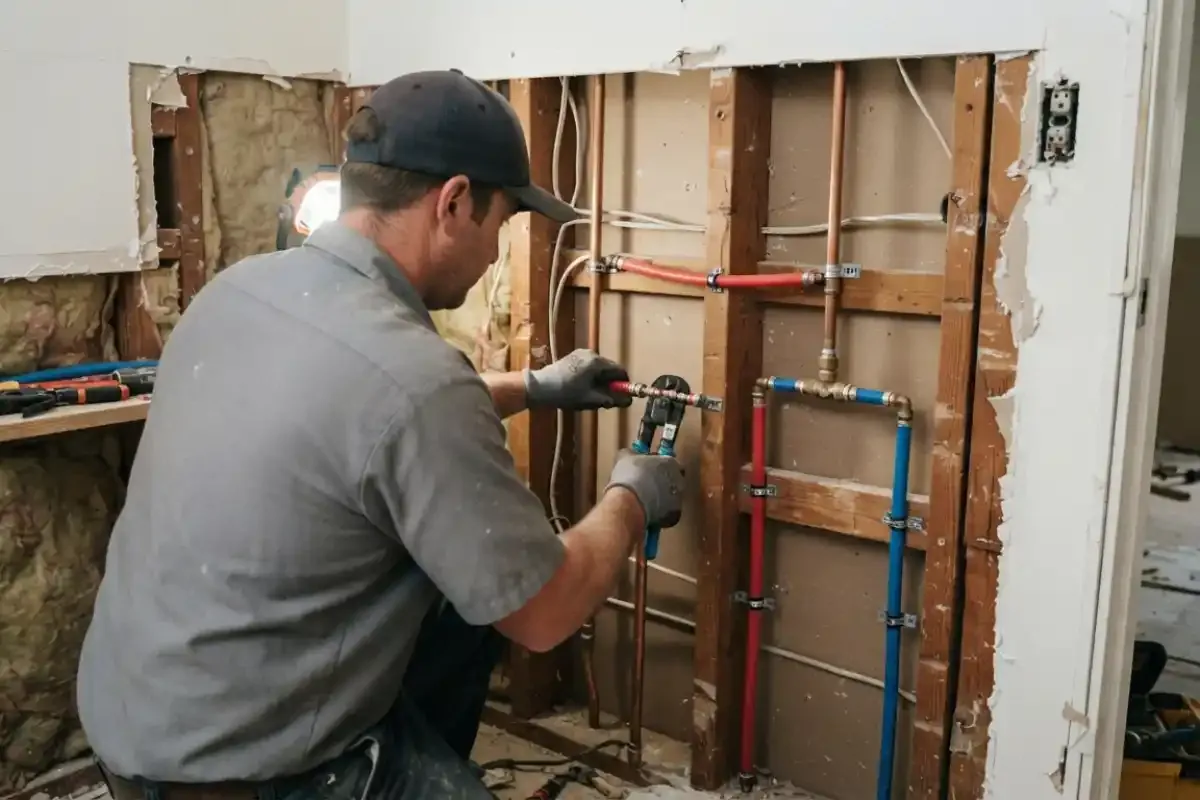
A repipe is a project, not a quick repair. A licensed plumber maps the system, shuts water to the house, and installs new lines from the main to each fixture. Access holes are cut in drywall at strategic points, then pipe is pulled or routed through the walls and attic or crawlspace. Fixtures reconnect, and the system is pressure-tested before the walls are closed.
Most repipes take several days, depending on size. The water is off for part of each day. We tell you in advance how long to plan for and which fixtures you cannot use. Drywall patching and paint are typically separate trades, so plan for that afterward.
How a repipe goes from first call to finished job.
- 1.
Walk the house.
We trace the existing pipe, find the main, and note fixtures and access points.
- 2.
Choose the material.
You hear PEX and copper options for your house and water.
- 3.
Confirm permits.
Ask the Claremont Building Division at (909) 399-5477 if your project needs a permit.
- 4.
Open and install.
We cut access openings, run new lines and reconnect fixtures.
- 5.
Test and flush.
Pressure testing and flushing check for leaks and clear debris.
- 6.
Close up.
You get a list of what drywall and paint work remains.
Weighing a repipe?.
Call us with your symptoms. We will tell you honestly if a repair will hold or a repipe is the better path.
Repipe or patch, a plain-spoken look.
Patching is cheaper now and costly later if the pipe keeps failing. Repiping is a bigger bill and a bigger disruption, but it ends the cycle. A good rule is to ask how many leaks you have fixed and how the cut sections looked. If the pipe inside was thick with scale or thin as paper, more repairs are borrowed time.
Not every house needs the whole thing. Some homes can repipe only one wing, a bathroom group or a line from the street, such as a failing service line. Leak detection can pin down where water is actually being lost, and a plumber can then decide whether partial or whole-house work fits.
What affects the cost of a repipe.
A repipe quote depends on the house, not just the pipe.
Size of the home.
More fixtures, bathrooms and floors mean more pipe.
Pipe material.
PEX and copper differ in materials and labor.
Access.
Open attics and crawlspaces are easier than finished slab-on-grade layouts.
Fixtures and valves.
Replacing shutoffs and connections adds work.
Drywall restoration.
Patching and paint are priced separately.
You get a clear price before work starts. Quotes follow an inspection of the actual pipes.
Getting the house ready.
Clear access points.
Move furniture and wall hangings from rooms where pipes run.
Plan for water off.
Store drinking water, and plan showers and laundry around the schedule.
Protect valuables.
Cover floors and remove breakables near the work.
Collect your history.
Note past leaks, repairs and where the stains appeared.
Repiping and the rest of your plumbing.
A repipe is the right time to look at the water heater connections, pressure regulator and shutoffs, since the walls are already open. If new fixtures or rooms are in your plans, see plumbing installation so the rough-in is done in one pass. If a pipe has already failed, our burst pipe repair page covers the stopgap.
Code, permits and licensing.
A repipe is governed by the California Plumbing Code, built on the Uniform Plumbing Code (UPC). The city says to call the Claremont Building Division at (909) 399-5477 to confirm permits, and the Contractors State License Board lists any plumber's license and complaint disclosure.
Repiping questions.
.
Galvanized pipe is gray, threaded at the fittings and often rusty or flaky near joints. A magnet sticks to it, which separates it from copper. If your water is brown after sitting overnight or pressure is low at many fixtures, galvanized is a likely reason. A plumber can confirm it by inspecting the main and under-sink lines.
.
Neither wins every case. PEX costs less, installs with fewer wall openings and resists pitting from hard water. Copper handles heat and sun and has a long track record, but costs more and can pit. We lay out both for your layout and let you choose.
.
It depends on the size of the house, the number of bathrooms and how much wall access is needed. Many jobs take several days with the water off for part of each day. We give you a schedule based on a visit, not a guess over the phone.
.
Ask the Claremont Building Division at (909) 399-5477. The city says plumbing and repipe work should be confirmed with them, and they can tell you what applies to your project. We can describe the scope so your call is quick.
.
Often yes. A bathroom group, a kitchen line or one failing branch can be replaced on its own. The catch is that old pipe left in place may fail next, so we tell you what the rest looks like.
.
Yes. We serve Claremont, La Verne, Pomona and Montclair. See our Montclair plumber page for how coverage works in 91763, then call to book a visit.