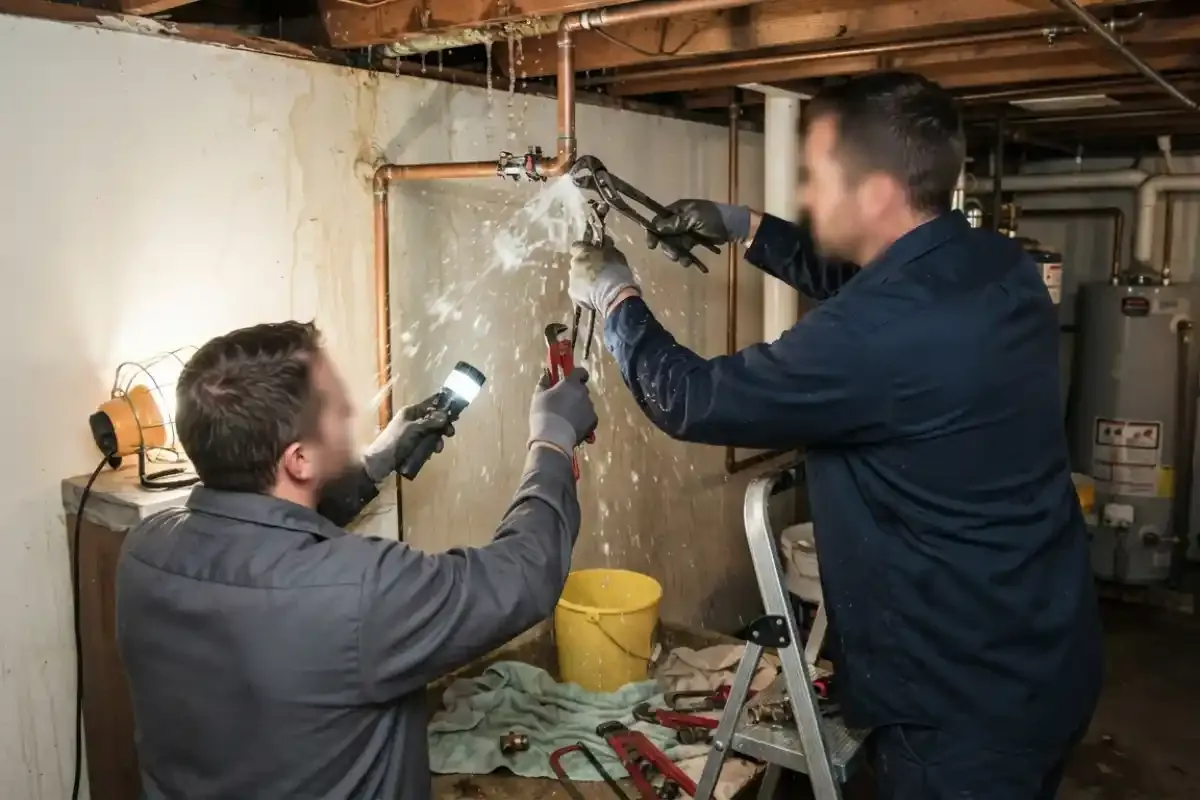
Water is coming out right now: do this first.
Burst pipe repair means stopping the flow, replacing or repairing the failed section, and drying out what got wet. The order matters. Water damage grows by the minute, so the shutoff comes before the phone call if you can reach it.
Find the main shutoff valve. In many homes it sits where the line enters the house, at a hose bib wall, in a garage, or in a crawlspace access. Turn a gate-style wheel clockwise until it stops, or turn a lever-style ball valve a quarter turn across the pipe. If the valve is stuck or buried, do not force it with a tool. Call dispatch and we will talk through the alternatives, such as the water utility.
Shutoff and first steps in order.
- 1.
Close the main valve.
Clockwise for a wheel handle, quarter turn for a lever.
- 2.
Open the lowest faucets.
This drains the pipes and relieves pressure at the break.
- 3.
Turn off the water heater.
Shut off the gas or breaker so the tank does not run dry and overheat.
- 4.
Move belongings.
Lift rugs, electronics and paper off wet floors.
- 5.
Call dispatch.
Tell us where the water was and whether the main is closed.
Power and gas safety around the water.
Water and electricity mix badly. If water is dripping near a ceiling fixture, running down a wall with an outlet, or standing around appliances, stay out of it. Switch off power at the panel only if you can get there without stepping through water. Otherwise leave it and say so when you call.
If you smell gas near a water heater or furnace, leave the building. Then call SoCalGas at 1-800-427-2200 from a safe place, and call 911 if life may be in danger. Never run a wet vacuum on a flooded floor or use extension cords in standing water.
Why pipes crack and burst.
Pipes rarely fail without warning. Corrosion thins old galvanized steel from the inside. Hard water scale builds up and narrows passages. A rare hard freeze can split exposed outdoor lines. Water hammer from a slammed valve, high water pressure and tree roots on buried lines also crack pipe.
Golden State Water's 2026 report puts local hardness at 97 to 330 mg/L, averaging 190 mg/L. That does not burst a pipe overnight, but it speeds up scale at fittings and in older metal. Pressure above what the fixtures are rated for adds stress. A plumber can test it at a hose bib.
Signs a pipe has cracked or is about to.
- Water spraying, dripping or pooling with no clear fixture cause.
- A wet stain spreading on a wall, ceiling or floor.
- A sudden drop in pressure at several fixtures.
- Banging or knocking when a valve closes.
- Brown or rusty water from the tap.
- A visible bulge, split seam or pinhole in an exposed pipe.
- The meter keeps moving with everything off.
Cracked or broken pipe: repair options.
Once the water is off, the plumber cuts out the bad section and chooses how to close the gap. Which method makes sense depends on the pipe, the location and how much of it looks tired.
| Pipe. | Typical repair. | Honest trade-off. |
|---|---|---|
| Copper. | Cut out the section and sweat in a new piece with fittings. | Strong and durable, but neighbouring pipe of the same age may be thin. |
| Galvanized steel. | Replace the section with new pipe and unions. | Often a sign the line is near the end, so patches may lead to repiping. |
| PEX. | Cut and join with crimp or expansion fittings. | Fast and flexible, but not suited to every exposed or sunlit run. |
| CPVC or PVC. | Cut and glue a coupling. | Quick, though old plastic can turn brittle. |
| Cast iron drain. | Replace with a no-hub coupling or new plastic. | Heavy, noisy work in tight spaces. |
What the plumber actually does on arrival.
First we confirm the main is off and check the damage area. Then we locate the break, which may mean opening a wall or ceiling a short distance. We cut out the damaged pipe, install new pipe and fittings, restore water slowly so we can watch for further leaks, and pressure-test. A burst that was part of a larger slow leak is a different case, and leak detection may be the next step.
Water still running?.
Call dispatch now. A plumber can be scheduled same day when available, and we help you contain the damage in the meantime.
First steps for water damage.
Plumbing repair stops the water, but the wet materials still need attention. Drywall, insulation and carpet padding hold moisture that can lead to mold. Pull up wet area rugs, open windows and run fans if the air is dry. Take photos of damage and the broken pipe before cleanup, and keep the old section if your plumber can spare it.
Call your insurance company soon. Coverage varies, and they may have steps they want you to follow before major cleanup. A water mitigation company can dry out walls and floors, which is separate from plumbing repair, and we can tell you what we found at the break.
What affects the cost of burst pipe repair.
The price follows the break, the access and the pipe.
Pipe material.
Copper, steel, PEX and plastic have different parts and labor.
Access.
A pipe under an open sink is easier than one inside a finished ceiling.
Number of failures.
One crack is a section repair. Several mean a longer run.
Time of the call.
Night, weekend and holiday dispatch are scheduled differently.
Wall or ceiling work.
Opening and patching drywall is its own scope.
You get a clear price before work starts. Cleanup and drying are separate from plumbing.
Before the plumber arrives.
Know your main valve.
Find it and test the handle so you can describe it.
Mark the break.
Note where the water first appeared and what is wet.
Open the access.
Clear cabinets, furniture and boxes around the pipe.
Keep pets away.
Close doors to the wet area and keep paws off the floor.
Do not patch a burst pipe with tape.
Wrap-style tapes and clamps may slow a drip for a few minutes but they do not hold under full pressure. For repiping or large replacements, ask the Claremont Building Division at (909) 399-5477 whether a permit applies. If the failed pipe runs under concrete, see slab leak repair for lines under concrete.
Standards and verification.
Replacement pipe and fittings should meet the California Plumbing Code, built on the Uniform Plumbing Code (UPC). After an emergency fix, check the plumber's license through the Contractors State License Board and ask the Building Division about permits.
Burst pipe questions.
.
Yes. Dispatch is available around the clock, including nights, weekends and holidays. Shut the main valve if you can, tell the dispatcher what you see, and a licensed plumber can be sent same day when available. We stay on the phone to guide your next steps.
.
Common spots are where the water line enters the house, in the garage, at the side of the house near a hose bib, or in a crawlspace access. A round wheel turns clockwise. A lever handle moves a quarter turn across the pipe. If you cannot find it or it will not turn, call and we will help.
.
Temporary clamps or wraps can slow a drip, but a pressure-rated repair needs cut pipe and proper fittings. Putting a patch on corroded metal can leave a failed section hidden. We advise shutting the water off and having a licensed plumber replace the damaged piece.
.
That depends on your policy. Many policies treat sudden pipe bursts differently from long-term leaks, so call your insurer soon and ask. Take photos before cleanup. We can describe what we found and what was replaced so your claim has a clear record.
.
Pull up wet rugs, run fans, and open windows when you can. Wet drywall and padding can grow mold, so dry them quickly or have them removed. A mitigation company handles drying equipment, which is separate from plumbing.
.
Frequent pinholes, rusty water, low pressure and visibly corroded pipe suggest the line is wearing out. One break in otherwise clean pipe is usually a section repair. We show you the condition of the pipe and discuss both paths.