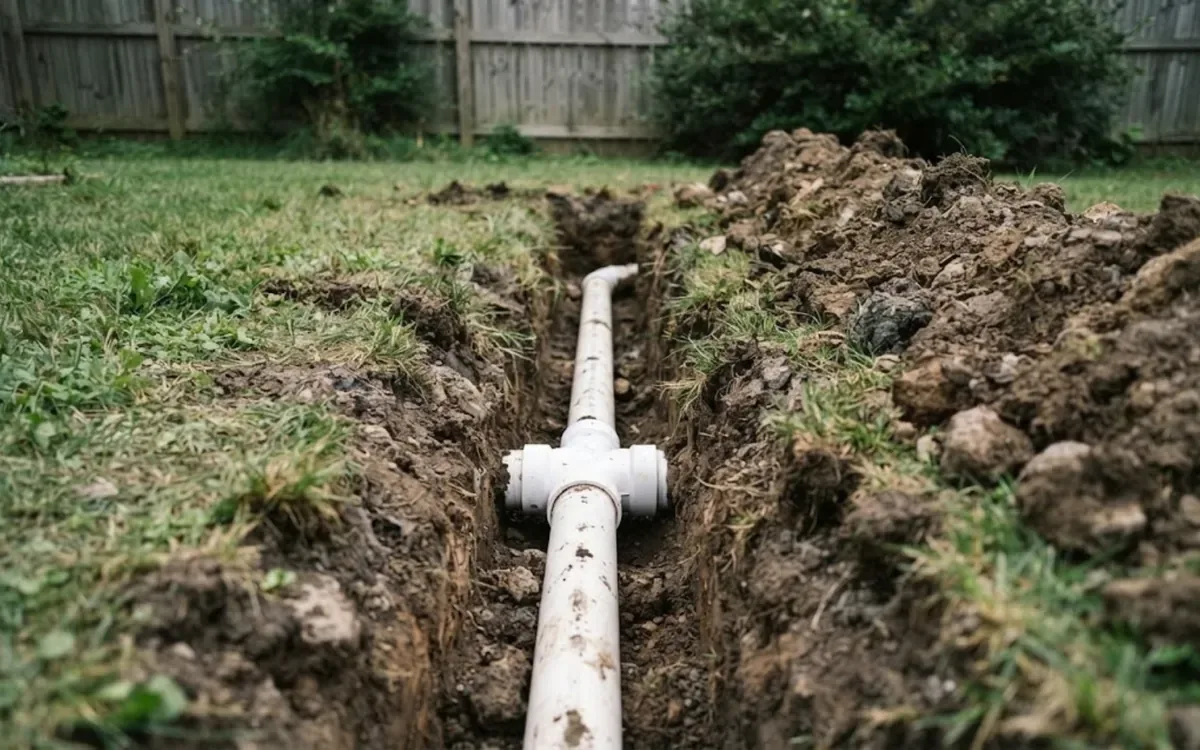
Sewer line repair means fixing a damaged section of the pipe that carries wastewater from your house to the City sewer main. The fix can be a dug-out replacement of the broken piece or a trenchless method that lines the pipe from the inside. Claremont Express Plumbing dispatches licensed plumbers around the clock, and the first job is always finding exactly where and why the pipe failed.
Backups that return after every cleaning.
One backup is a clog. A backup every few weeks is a broken pipe that keeps catching debris. Cleaning removes the symptom, but a cracked joint, an offset section or a belly in the pipe will collect solids again.
Other signs are a patch of lawn that stays soggy, a sewer smell outdoors, sinkholes or a slab that has sunk near the line. If the cable keeps stopping at the same spot, tell the plumber. That is often where the break is.
Signs the lateral may need repair.
- Backups that return soon after the line is cleared.
- Cable or camera stops at the same distance every time.
- Soggy ground or sewage smell over the line.
- Sinking soil, a new dip in the yard or a cracked driveway near the pipe.
- Gurgling drains with no clog found.
- A camera that shows roots, offsets, cracks or a flattened pipe.
Who owns the lateral and why it matters.
The City of Claremont owns and maintains the sanitary sewer main, which is usually in the middle of the street. The property owner is responsible for the private lateral from the house to that main. The City does not respond to problems inside a private lateral, so a break in your section is yours to repair.
Before any work, ask the plumber to confirm the damage is in your section and not the main. The City's Engineering Division at (909) 399-5465 can help locate the lateral. For permit questions on a dig or a replacement, ask the Claremont Building Division at (909) 399-5477 instead of assuming.
Pipe materials and how they fail.
The City's own sewer system includes vitrified clay, PVC, asbestos cement, ABS, reinforced concrete and cured-in-place lining. Private laterals vary even more, and what you have depends on when your house was plumbed and whether the line has been replaced.
In general, older clay pipe is hard and long-lasting but comes in short sections with many joints, and roots enter at those joints. Cast iron corrodes from the inside. Plastic pipe such as ABS and PVC resists roots, but can crack if the soil shifts or it was bedded poorly. Knowing the material helps choose between a patch, a replacement and a liner.
| Option. | Best for. | Trade-off. |
|---|---|---|
| Spot repair by excavation. | One broken or offset section in reachable soil. | Digs a trench, and landscaping or paving has to be restored. |
| Full replacement by open trench. | Pipe that is failing along most of its length. | The most disruption, and usually the most durable result. |
| Cured-in-place lining. | Cracks, root entry or worn pipe that is still round. | Needs a pipe clear of collapse, and it reduces diameter slightly. |
| Pipe bursting. | Replacing a failed line with minimal digging. | Needs entry and exit pits, and is not right for every soil or layout. |
Dig or line it? The decision.
Trenchless is not automatically better, and open digging is not automatically worse. Lining can save a driveway, a mature tree or a patio, and it often costs less in restoration. But a liner needs a pipe that is still round and continuous. A collapsed or severely offset section has to be dug and fixed first.
Digging, on the other hand, lets you replace the pipe with new material and correct a belly in the grade, something a liner cannot do. If the line has a sag that holds water, a liner will follow the sag. The camera footage should drive the choice, so insist on seeing it. Our sewer inspection service is built for that.
Not sure if it is a clog or a break? Call dispatch.
A licensed plumber can clear the line, run a camera and show you what is wrong.
What happens during a repair job.
From call to completed repair.
- 1.
Stop water use and call.
Dispatch gets the basics and sends a licensed plumber.
- 2.
Clear and camera the line.
The line is opened first, then recorded to find the damage and its distance from the cleanout.
- 3.
Locate on the surface.
A locator marks the spot above ground so digging is limited to what is needed.
- 4.
Choose the method.
The plumber walks through dig, line or burst based on the footage, the soil and your property.
- 5.
Repair and test.
The new section or liner goes in, then water is run and the line is checked again.
- 6.
Close up.
Soil, paving or landscaping is restored as agreed, and any needed permit is arranged by asking the Building Division.
What affects the price of sewer line repair.
Cost factors for a lateral repair.
Sewer repair covers everything from a small patch to a full replacement, so these are the factors that move the cost.
Length of damaged pipe.
A 4 foot repair and a 60 foot replacement are very different jobs.
Depth and soil.
Deeper pipe and harder ground mean more excavation time.
Surface restoration.
Concrete, pavers, lawn and landscaping all have to be put back.
Method.
Spot digging, lining and bursting use different equipment and crews.
Permits and inspection.
Ask the Claremont Building Division at (909) 399-5477 what a specific job needs.
You get a clear price before work starts, and an emergency visit to clear the line does not commit you to a repair.
Before the plumber arrives.
While you wait.
Stop using water.
A broken lateral can saturate the soil or spill into the house. Hold all flushes and laundry.
Locate your cleanout.
Clear access to it so the camera can go in right away.
Note the history.
Past clogs, root problems and any earlier repairs help the plumber.
Keep electrics clear of water.
If sewage is in a garage or near outlets, stay away and cut the power only if the panel is safe to reach.
If the repair is not urgent right now.
If the line is flowing and the camera shows early cracks, you may have time to plan. Compare an estimate for lining against one for digging, and ask each contractor for the footage. A homeowner who has only had the line cabled has not yet seen the pipe.
For regular maintenance in a line with scale or grease, hydro jetting can slow the rebuild. If the stoppage is the only issue, see sewer line cleaning. Homeowners in nearby towns can check our Pomona coverage as well.
Check who you are hiring.
California's Contractors State License Board lists licenses and complaint disclosures at cslb.ca.gov. A repair that involves sewer piping falls under plumbing work, so look up any contractor before signing. A responsible contractor will not mind you checking.
Code, permits and license.
Any new section of sewer pipe must meet the California Plumbing Code, built on the Uniform Plumbing Code (UPC). Ask the Claremont Building Division at (909) 399-5477 if the repair needs a permit, and check the plumber's license with the Contractors State License Board.
Sewer line repair questions.
.
Yes. Dispatch runs 24/7, and licensed plumbers are sent to sewer failures at night and on weekends. The first visit usually stops the backup and locates the damage with a camera. A full repair is then planned around the pipe, soil and surface, and you decide before it starts.
.
In Claremont, the private lateral from your house to the City main is the property owner's responsibility. The City owns the main in the street and does not respond to problems inside a private lateral. The City's Engineering Division at (909) 399-5465 can help locate it.
.
Not always. Lining saves landscaping and paving and suits cracks and root entry in a pipe that is still round. It cannot fix a collapse or a deep sag. Digging replaces the pipe outright and can correct slope. The camera footage should decide, not the sales pitch.
.
We cannot say for a specific job. The City of Claremont says to call the Building Division to confirm for plumbing work. Ask the Claremont Building Division at (909) 399-5477 before a dig or replacement, and tell them what is being done.
.
The cable stops at the same spot, drains back up repeatedly, the lawn above the line stays wet or sinks, or a camera shows a flattened or missing section. A collapsed line cannot be cleared properly and usually needs a dug repair, so it is worth a camera look early.
.
Often yes for a while. Cutters and jetting remove roots, and a liner can seal the joints they enter. Roots return if the opening stays, so repeat root trouble usually points to lining or replacement.