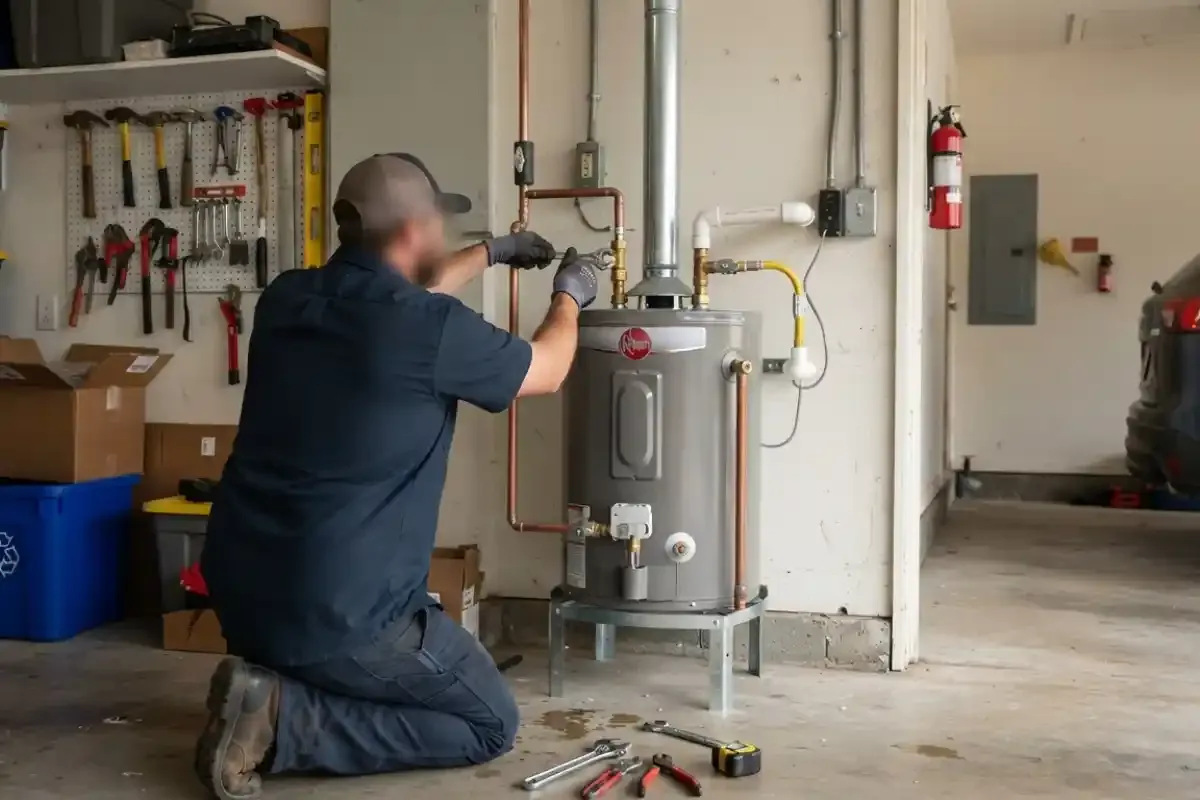
What a proper installation includes.
Water heater installation means setting a new tank or tankless unit in your home and connecting the gas or electric supply, water lines, vent, relief valve and drain. A good install is more than a swap of the heater. It is the whole set of connections around it, done to the California Plumbing Code.
Planned installs follow a remodel, a fuel change, a bigger household or a decision to replace an aging tank before it leaks. If your current heater has already failed, water heater replacement covers the urgent version of this work.
Sizing: the first decision.
Tank size should match how your household uses hot water, not the room it fits in. A small household that showers at different times does fine with a smaller tank. A large family with a soaking tub and a dishwasher running at the same time needs more storage or faster recovery.
Plumbers look at bathroom count, peak morning demand and fuel type. Gas tanks recover faster than electric ones of the same size, so gas can often be a size smaller. Too small means cold showers. Too large wastes heat.
Venting and combustion air on gas units.
A gas heater has to push exhaust out of the house. The flue is sized and pitched so combustion gases rise and leave, and the heater needs enough air in the room to burn cleanly. A closet with a louvered door or a garage with open vents is typical.
This is a safety item. A poorly drawn flue can let carbon monoxide into the house. The plumber checks draft at the draft hood and tests every gas joint for leaks.
If you smell gas at any point, leave the building, then call SoCalGas at 1-800-427-2200 from a safe location. Call 911 if anyone may be in danger.
Expansion tank, relief valve and pressure.
Heated water expands. In a closed plumbing system, where a pressure regulator or check valve stops water from flowing back to the street, that expansion has nowhere to go. Pressure rises, and the temperature and pressure relief valve starts to weep or the heater's fittings wear early.
An expansion tank absorbs that extra volume. A plumber tests your static water pressure with a gauge and installs a tank where the system needs one. The relief valve gets a discharge line piped to a safe termination, never capped.
Planning a new heater? Call to book.
Tell dispatch what you have now and what you want, and a licensed plumber will plan the install with you.
Earthquake strapping is required.
California Health and Safety Code 19211 requires new and replacement water heaters to be braced, anchored or strapped to resist falling or horizontal movement in an earthquake. It applies to heaters up to 120 gallons that have a readily available pre-engineered strapping kit.
Typically two straps, one near the top and one near the bottom of the tank, anchor into studs or masonry. A new heater without them is incomplete. For any permit question about your specific install, call the Claremont Building Division at (909) 399-5477.
Choosing the type that suits your home.
| Type. | Good for. | Trade-off. |
|---|---|---|
| Gas tank. | Fast recovery in homes already plumbed for gas. | Needs a good flue and combustion air. |
| Electric tank. | Homes with no gas service. | Slower recovery, often higher running cost. |
| Tankless. | Endless hot water and wall-mounted compact size. | Higher install cost and yearly descaling, see tankless water heater. |
| Larger or second tank. | Big households and long runs. | More floor space and standby heat loss. |
Hard water and what it means for the new heater.
Claremont's water comes from Golden State Water Company's system, a mix of treated groundwater and imported supply. The utility's 2026 report shows hardness of 97 to 330 mg/L, averaging 190 mg/L, which is about 11 grains per gallon on average.
New tanks scale up in that water just like old ones. Plan an annual flush from the start, and consider a water softener and filtration system if you want to protect the heater and fixtures at the same time.
Questions to settle before install day.
- Gas, electric or tankless.
- Tank capacity for your household.
- Where the heater will sit and whether the space is ventilated.
- Whether the flue and gas line are in good shape.
- If the system needs an expansion tank.
- Where the relief valve discharge pipe will run.
- Who removes the old tank.
How the install day goes.
Planned installation, start to finish.
- 1.
Walk-through and plan.
The plumber inspects the space, fuel, flue and existing connections, then confirms the unit.
- 2.
Drain and disconnect.
Water, gas or power are shut off and the old tank is drained and unhooked.
- 3.
Set and connect.
The new unit goes in place with new connectors, shutoffs and a relief valve and drain line.
- 4.
Strap, vent, test.
Straps, flue and gas joints are checked, then the heater is fired through a full heating cycle.
- 5.
Haul away.
The old tank leaves the property with the plumber.
What goes into the price of an install.
Installation price factors.
Installs vary a lot, so we price the actual job. You get a clear price before work starts.
Unit type and capacity.
A tank and a tankless unit differ in cost and in the work around them.
Fuel and gas or electrical work.
A larger gas line or a new circuit adds labor.
Venting.
A new flue run or a change in routing takes time and materials.
Code add-ons.
Strapping, expansion tank, relief valve discharge and shutoffs each add parts.
Access.
Attic or crawlspace installs take longer than a garage floor.
A fair estimate requires seeing the site. The plumber confirms the plan and gives the full price before any work begins.
Before the plumber arrives.
What to do before install day.
Clear the space.
Move boxes and stored items at least a few feet back from the heater and the path to it.
Find your shutoffs.
Know where the main water valve and the gas shutoff are.
Note the old unit.
Write down the capacity, fuel and age from the data plate.
Plan the downtime.
The home will be without hot water while the old tank comes out and the new one is connected.
Planned beats rushed.
An old heater that still works gives you time to compare sizes, fuels and tankless before a leak forces a quick decision.
If your current heater is still limping along, a plumber can also look at water heater repair. We schedule installs in Claremont and in nearby Montclair.
Code, strapping and permit questions.
A new install must meet the California Plumbing Code (built on the Uniform Plumbing Code, UPC), and Health and Safety Code section 19211 requires earthquake strapping. For permit questions call the Claremont Building Division at (909) 399-5477.
Water heater installation questions.
.
A full install covers the new unit, new water and gas or electrical connections, a temperature and pressure relief valve with a discharge line, a vent check on gas heaters, earthquake strapping and removal of the old tank. Extras like an expansion tank are added where the system needs them.
.
Size depends on the number of people, how many bathrooms are used at once and the heater type. Gas tanks recover faster than electric, so they can be a size smaller. A plumber looks at your peak demand and recommends a capacity rather than matching whatever was there.
.
Often, if your plumbing is a closed system with a check valve or pressure regulator. A plumber measures static pressure with a gauge. If the system has no room for thermal expansion, an expansion tank protects the relief valve and fittings.
.
Yes. Health and Safety Code 19211 requires new and replacement residential water heaters to be strapped or braced against earthquake movement, for units up to 120 gallons that have a strapping kit available. A proper installation includes it.
.
Yes. Removal and haul-away of the old tank is part of the job, so it does not stay in your garage or side yard.
.
We will not guess. Permit requirements depend on the specific job, so ask the Claremont Building Division at (909) 399-5477. Plumbers who do this work regularly can tell you what they usually see, but the city has the final word.