What the numbers say about Claremont water.
Golden State Water Company serves Claremont from a blend of treated groundwater from the Chino, Pomona and Upper Claremont Heights basins and imported State Water Project water. Its 2026 Annual Water Quality Report, based on 2025 data, lists hardness as calcium carbonate from 97 to 330 mg/L, with an average of 190 mg/L.
In grains per gallon, that is 5.7 to 19, averaging 11. Hardness changes with the source blend, so your tap can read differently in different months. For anything more specific about your address, ask the utility.
What hard water leaves behind.
Hardness is dissolved calcium and magnesium. Heated or evaporated, it leaves scale. You see it as white crust on faucet aerators and showerheads, spots on glass, a film on tubs and tile, and stiff-feeling laundry.
Inside pipes and appliances the effect is quieter. Scale builds on heating elements, the floor of a tank water heater and the narrow passages of a tankless exchanger. That is why our water heater repair calls often start with a scaled-up element.
Signs scale is the problem.
- White chalky crust around faucets and showerheads.
- Cloudy spots on glasses and dishes after the dishwasher.
- Soap that does not lather well and leaves a film.
- Showerhead spray that narrows or sputters over time.
- A noisy water heater with rumbling or popping.
- Heater elements or a tankless unit that fail early.
- Dull, stiff laundry.
Softener, filter and reverse osmosis: they do different jobs.
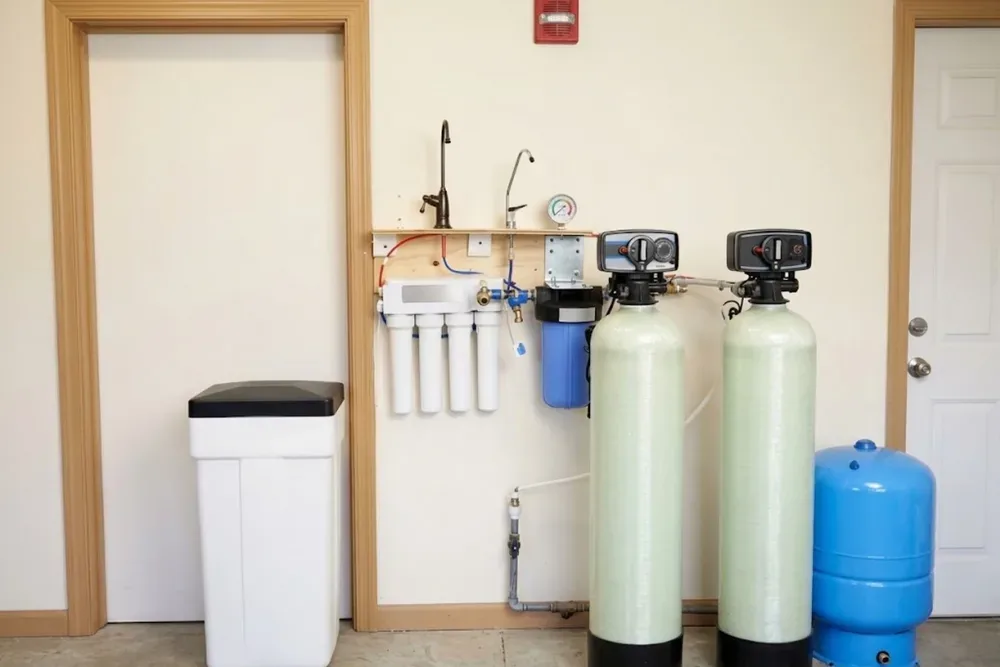
These three are not interchangeable, and a plumber who lumps them together is guessing. A softener removes hardness. A filter removes particles or taste and odor. Reverse osmosis polishes drinking water at one tap.
| System. | What it does. | What it does not do. |
|---|---|---|
| Salt-based softener. | Swaps calcium and magnesium for sodium or potassium through ion exchange, so scale stops forming. | Does not filter taste, odor or sediment, and needs salt and a drain connection. |
| Whole-house carbon or sediment filter. | Catches sediment and reduces chlorine taste and odor. | Does not remove hardness. |
| Reverse osmosis at the kitchen sink. | Treats drinking and cooking water with a membrane and small storage tank. | Treats one tap only, and wastes some water to drain. |
| Conditioner without salt. | Changes how scale forms on surfaces. | Does not remove hardness, so results are debated. |
If scale is your complaint, a softener is the tool. If the water tastes of chlorine, add a filter. If you want a clean glass at the sink, reverse osmosis does that at one faucet. Many homes use two of these together. We make no health claims for any of them. Questions about contaminants belong with your water utility's report.
Not sure what you need? Ask a plumber.
Describe the scale, taste or spots you see, and dispatch will schedule a licensed plumber to talk it through.
Sizing a softener to a Claremont household.
A softener is sized by its grain capacity, the amount of hardness it can remove between regenerations. The plumber multiplies your household's daily water use by the hardness level, using Claremont's roughly 11 grains per gallon average as a starting point, and picks a unit that regenerates on a sensible cycle.
Too small and it regenerates constantly, wasting salt. Too large and water sits in the resin bed. A family of four will use a different size than a couple.
What the installation involves.
A softener installs on the main water line after the pressure regulator and before the water heater. It needs a drain connection for the regeneration backwash, a nearby outlet for the control head and a bypass valve so you can isolate it. Outdoor hose bibs are normally left on untreated water.
Filtration and reverse osmosis installs are lighter. Whole-house filters go on the main line with a pressure gauge and bypass. RO systems fit under the sink with a dedicated faucet and a drain saddle on the kitchen drain. For tankless owners, softening ahead of the unit cuts scale in the heat exchanger. See tankless water heater.
What a visit looks like.
Water treatment from first call to first glass.
- 1.
Call and describe the problem.
Tell dispatch what you see, such as scale, spots, taste or a failing heater.
- 2.
Look at the plumbing.
The plumber checks the main line, water pressure, drain access and space.
- 3.
Pick and size the system.
You get a plain explanation of what each option does and does not do.
- 4.
Install and set up.
The unit is plumbed in with a bypass, tested for leaks and programmed.
- 5.
Explain upkeep.
You learn about salt refills, filter changes and when to service it.
What affects price.
What drives the cost.
Costs depend on the system you choose and the house it goes into. You get a clear price before work starts.
System type.
A softener, a whole-house filter and an RO unit cost different amounts.
Capacity.
Larger households need more softener capacity.
Plumbing and drain access.
A softener needs a drain and power nearby, and long runs add labor.
Existing pipe condition.
Old galvanized or corroded lines may need work before tying in.
Upkeep.
Salt, filter cartridges and membrane changes are ongoing costs.
Water treatment is a planned job, so the price is set after the plumber sees your layout and your goals.
Before the plumber arrives.
What to do before the visit.
Find the main shutoff.
Know where the water enters the house and that the valve turns.
Clear the area.
Open up floor space near the water heater or main line.
Note the problem.
List the spots, scale, odor or taste you want solved.
Consider the drain.
Identify the nearest floor drain or laundry standpipe.
Buy the system for the problem, not the sales pitch.
Hardness and drinking-water quality are different questions. A softener answers the first and does nothing for the second. If a seller claims one box fixes everything, ask exactly which contaminant it targets and how upkeep works.
If your heater has already failed from scale, water heater replacement is the first step, and a softener protects the new tank. We also serve Pomona.
What to verify before you buy.
Softener and filtration installs connect to your supply line under the California Plumbing Code, built on the Uniform Plumbing Code (UPC). Test your tap against the Golden State Water Company report first, and check the installer's license with the Contractors State License Board.
Softener and filtration questions.
.
Golden State Water Company's 2026 report lists hardness from 97 to 330 mg/L, averaging 190 mg/L, which is about 5.7 to 19 grains per gallon and an average of 11. Values shift with the supply mix, so ask the utility about your address.
.
It depends on what bothers you. If you have scale on fixtures, spotted glassware or a heater that keeps scaling up, a softener addresses those. If your concern is taste, a filter or reverse osmosis fits better.
.
A softener removes the minerals that cause scale. A filter catches sediment or reduces chlorine taste and odor. They do different jobs, and a filter does not soften water.
.
No. Reverse osmosis treats drinking water at one tap and is not built for whole-house flow. Many homes pair a softener for scale with an RO unit under the kitchen sink.
.
It can reduce scale on elements and tank floors, which are common causes of failed heaters. It does not stop all failures, but it takes away a major stress on both tank and tankless units.
.
Yes. Salt-based units need salt refills, occasional resin bed cleaning and a check of the brine tank and drain line. Filters need cartridge changes on schedule, and RO membranes wear out eventually.