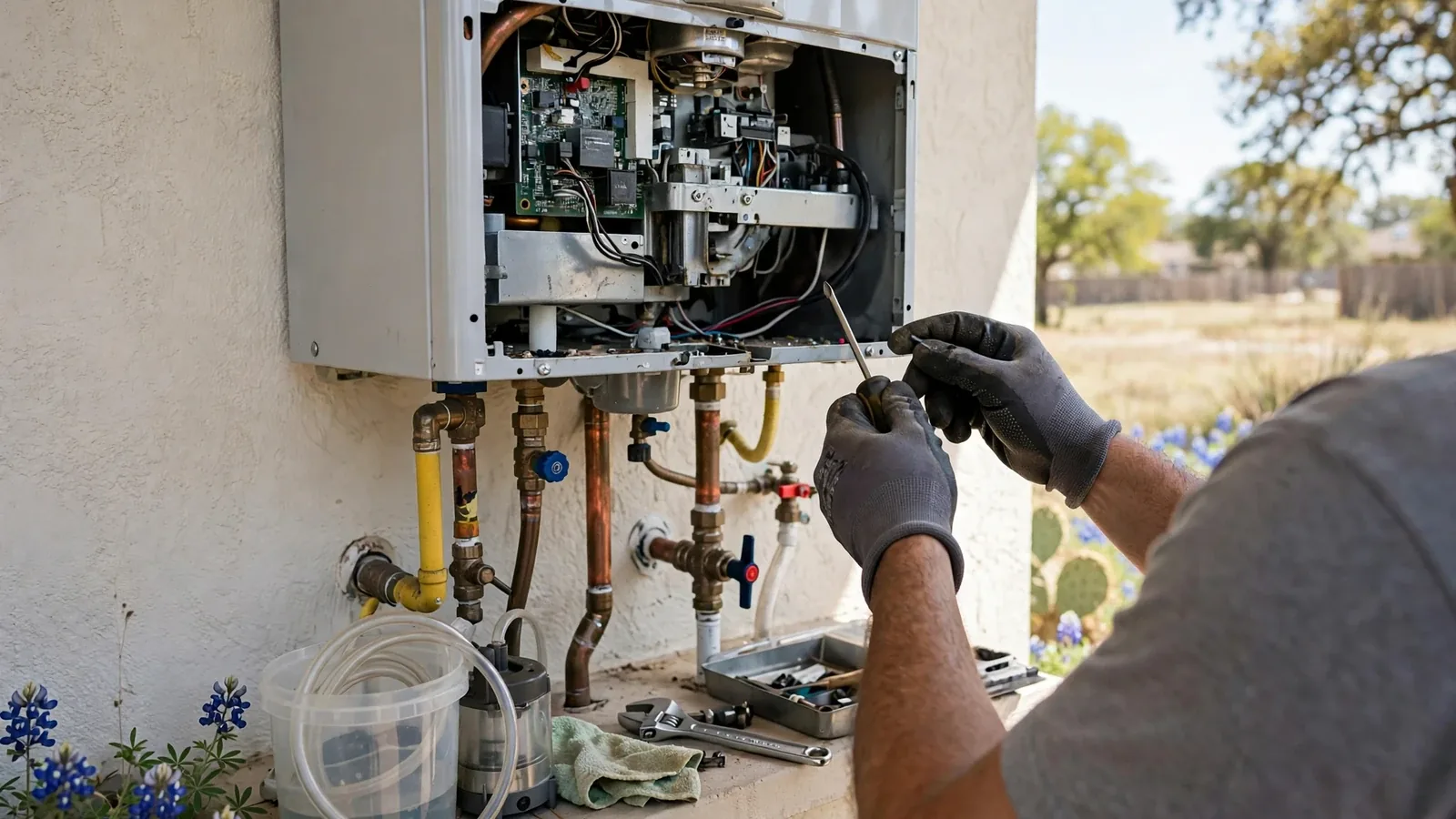
How a tankless heater works and what it needs.
A tankless water heater has no storage tank. When a hot tap opens, a flow sensor fires a gas burner or electric elements, and water is heated as it passes through a heat exchanger. You get hot water as long as the unit can keep up with the flow. That limit is why sizing matters.
That demand is the catch. A gas tankless unit often needs a larger gas line than a tank, and a venting setup made for higher exhaust temperatures. An electric unit can need a heavy new circuit. Those requirements, not the heater itself, drive most of the cost of a switch.
Tankless installation: what changes from a tank.
Tankless installs are wall-mounted, usually in a garage, exterior wall or utility closet. The plumber checks the gas pipe size against the unit's maximum input, reroutes or replaces venting where needed and adds isolation valves. Those valves matter because they let the unit be flushed later.
Size by flow rate and temperature rise, not by gallons. If the shower, dishwasher and washing machine run together, the unit must deliver all of them at once. A household that does this regularly may need a larger unit or a second one. For a tank-based comparison, see water heater installation.
Hard water and scale in Claremont.
Golden State Water Company's 2026 water quality report lists Claremont hardness from 97 to 330 mg/L, with an average of 190 mg/L, about 11 grains per gallon. That is hard water.
A tankless heat exchanger has narrow passages, so scale hurts it faster than it hurts a tank. It cuts flow, causes error codes and shortens the exchanger's life. This is the main maintenance reality of owning a tankless unit here.
Tankless flush and descaling.
Descaling is a maintenance flush that dissolves mineral buildup inside the heat exchanger. A plumber closes the unit's isolation valves, connects a small pump and hoses to the service ports and circulates a food-grade descaling solution, usually white vinegar or a manufacturer-approved cleaner, through the exchanger for roughly an hour. Then the unit is rinsed and the inlet screen is cleaned.
How often depends on hardness and use. In water as hard as Claremont's, many manufacturers recommend flushing once a year, and heavily used units may need it more. Signs it is overdue include lukewarm water at full flow, a drop in flow rate, a rumbling or popping from the unit and an error code for temperature or flow.
The plumber also cleans the inlet water screen and checks the error log during the same visit. Flushing is cheaper than replacing a scaled exchanger. It is also the reason isolation valves should be part of any install. A softener ahead of the heater cuts scale at its source. See water softener and filtration.
Signs your tankless needs service.
When to call about a tankless unit.
- Hot water that fades to lukewarm when two fixtures run at once.
- An error code on the display that returns after a reset.
- Lower flow at the shower than you used to get.
- Popping or kettle-like noises from the heat exchanger.
- Water that swings between hot and cold, the cold sandwich effect.
- A unit that will not ignite or shuts off after a few seconds.
- No hot water at all, which can be a tripped breaker or a gas supply problem.
Tankless install, repair or flush? Call us.
Describe the unit and the symptom, and a licensed plumber will schedule the visit.
Repair: what plumbers check first.
A tankless fault usually starts with something simple. The plumber checks the gas supply and meter, the vent for blockages, the inlet water filter screen and the flow sensor, then reads the error code against the manufacturer's chart. Many faults are scale on the exchanger or a clogged inlet screen.
Real repairs include replacing a flow sensor, thermistor, igniter or fan motor, and clearing a vent. Parts and models vary by brand, so the visit starts with the unit's data plate. If a gas unit smells of gas, leave the building and call SoCalGas at 1-800-427-2200 from a safe place, and 911 if anyone may be in danger.
Tankless or tank: the honest comparison.
| Factor. | Tankless. | Tank. |
|---|---|---|
| Hot water supply. | Continuous within flow limits. | Limited by tank size, then recovery time. |
| Install cost. | Higher, with gas, venting or electrical upgrades. | Lower for a like-for-like swap. |
| Maintenance. | Annual flush in hard water. | Occasional flush and anode check. |
| Space. | Compact wall unit. | Needs floor space. |
| Standby loss. | None, heats only on demand. | Tank keeps water hot all day. |
If your tank has already failed, water heater replacement can set a new one quickly while you decide about tankless later.
What determines the price.
Factors that set tankless pricing.
Tankless jobs vary widely, so the price reflects your house. You get a clear price before work starts.
Unit size and brand.
Flow capacity and efficiency tiers change the cost of the heater.
Gas line and venting.
A larger gas pipe or a new vent run is often the biggest add-on.
Electrical needs.
Electric units may need a new circuit and panel capacity.
Isolation valves and extras.
Service valves, a recirculation setup or a softener add parts.
Flush or repair scope.
A routine descale is simpler than a part replacement.
Price depends on what your existing gas, venting and plumbing look like. The plumber confirms scope on site, then gives the price.
How a visit goes.
Install or service visit.
- 1.
Call and describe the setup.
Tell dispatch the brand, age and symptoms, or what you want installed.
- 2.
Inspect.
The plumber checks gas size, venting, isolation valves and error history.
- 3.
Do the work.
Install, repair or flush is carried out and the unit is tested at several flow rates.
- 4.
Explain maintenance.
You leave with a clear flush schedule suited to local hard water.
Before the plumber arrives.
Helpful to have ready.
Clear the area.
Move storage away from the unit and the plumber's path.
Find the model.
Read the model number and any error code on the display.
Know the symptom.
Note when the water goes cold, such as at the shower or with the dishwasher running.
Locate shutoffs.
Find the gas and water valves feeding the heater.
The flush is the habit that pays.
Most premature tankless failures in hard-water areas come from scale and neglected maintenance, not from bad units. A yearly flush with isolation valves in place is much cheaper than a new heat exchanger.
We serve homes in Claremont and in La Verne.
Standards that apply to tankless units.
Venting, gas sizing and water connections for tankless heaters follow the California Plumbing Code, which is built on the Uniform Plumbing Code (UPC). Always follow the manufacturer's installation manual too, and verify the installer's license with the Contractors State License Board.
Tankless water heater questions.
.
Many manufacturers advise a yearly flush in hard water. Golden State Water reports Claremont hardness averaging about 11 grains per gallon, so scale builds steadily. Heavy use or no softener can shorten the interval, and your unit's manual has its own guidance.
.
It depends. You get endless hot water within the unit's flow limit and no standby loss, but the install costs more and needs yearly descaling. It suits households that value continuous hot water and wall space more than low upfront cost.
.
Codes often point to flow, ignition, venting or temperature problems, and scale is a frequent cause. A plumber reads the code against the manufacturer's chart, checks the inlet screen and the vent, and flushes the exchanger if scale is the trigger.
.
Yes, in many homes. The plumber checks the gas pipe size, vent routing and electrical capacity first, because tankless units often need upgrades. Ask about water heater installation if you want to compare both setups.
.
A softener removes the hardness that causes scale, so the heat exchanger stays cleaner longer. It does not eliminate maintenance, but it can stretch the time between flushes and protect fixtures too.
.
Leave the building immediately and call SoCalGas at 1-800-427-2200 from a safe location. Call 911 if anyone may be in danger. Do not try to relight or reset the unit until a licensed plumber has inspected it.