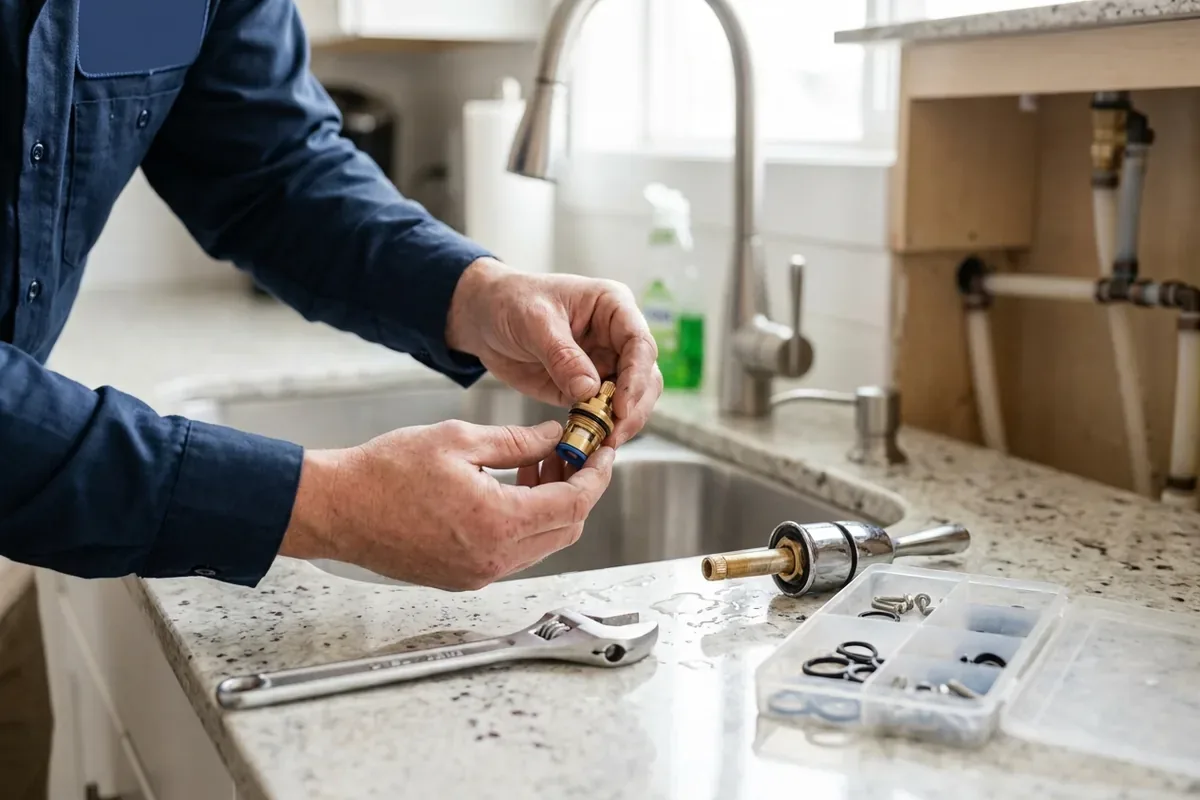
Emergency: a faucet or supply stop that will not shut off.
Faucet repair means fixing the part that controls water at a sink, tub or shower: the cartridge, valve seat, stem, aerator or the small shutoff valve beneath. When one fails, you get a drip, a stream that never stops or a handle that spins without effect.
The first move is the angle stop under the sink. Turn it clockwise, gently. If it will not close, or it closes and water keeps coming, go to the house main shutoff. If you cannot find or close it, Golden State Water Company's 24-hour line is 1-800-999-4033. The utility maintains the line up to the meter, and everything after that is yours.
Do not keep forcing a corroded stop. Old multi-turn valves can snap at the stem, and that turns a drip into a spray.
Valves that fail: supply stops and broken connections.
A supply stop is the small oval or round valve between the wall pipe and the faucet line. They sit for years without being turned, then seize up or leak at the packing nut the first time anyone touches them. A broken or burst supply valve, or a braided line that has split at the crimp, puts water on the floor in seconds.
Plumbers replace the whole stop with a quarter-turn ball valve, which is less likely to seize than the old compression type. If the pipe behind it is corroded or soft, the repair gets bigger. Copper that has pitted from hard water or galvanized steel in an older home may need a section cut out and new pipe joined in. If water is spraying from the wall itself, see burst pipe repair.
Faucet and valve signs that call for a plumber.
- A faucet that drips constantly even when the handle is fully closed.
- Water that will not stop when the under-sink stop valve is turned.
- Handle that spins loosely, sticks or needs more force each month.
- Moisture or a green crust on the supply valve or braided line.
- Low flow from one faucet only, with the others normal.
- Shower or tub spout that keeps running after the handle is off.
- Stained drywall or a soft spot behind the shower or tub wall.
Dripping faucets: what is wearing out inside.
A steady drip can waste gallons a day. What matters is which design you have. Compression faucets use a rubber washer and a brass seat. Cartridge and ball faucets use a sealed insert. Ceramic disc models use two polished discs. Each wears differently.
Hardness hurts all of them. Golden State Water's 2026 water quality report puts Claremont water between 97 and 330 mg/L hardness, about 5.7 to 19 grains per gallon, averaging 190 mg/L. That scale builds up on seats, strains cartridges and clogs aerators. A water softener addresses the cause for the whole house, though it is a planned project, not an emergency fix.
Shower and bathtub faucet leaks.
Tub and shower valves hide behind tile. A bathtub faucet that drips from the spout or a shower that will not shut off usually has a worn cartridge, a damaged seat or a failed diverter. Replacing the cartridge is often possible from the front. Some valves, especially older soldered bodies, need access through the back wall.
Check the ceiling below or the wall on the other side of the tub. A damp stain or peeling paint can mean the leak is behind the wall and has been running for a while. In that case, a plumber may recommend a leak detection check before any tile is opened.
| Problem. | Likely cause. | Usual repair. |
|---|---|---|
| Steady drip from the spout. | Worn cartridge, washer or seat. | Replace the cartridge or washer and clean or replace the seat. |
| Water will not shut off at the stop. | Seized or corroded valve. | Replace with a quarter-turn valve. |
| Leak under the sink. | Split supply line or loose nut. | New braided line, tighten or replace the stop. |
| Tub spout keeps running. | Failed shower cartridge or diverter. | Replace cartridge or valve body. |
| Handle leaks at the base. | Worn O-rings or packing. | Replace O-rings, or the whole faucet if the body is pitted. |
| Weak flow. | Clogged aerator or debris in the cartridge. | Clean or replace parts. |
What the plumber does on a visit.
- 1.
Isolate the water.
They locate the shutoff, test it and replace it if it fails.
- 2.
Identify the fixture.
They remove the handle or trim and check cartridge type, seat and O-rings.
- 3.
Test the supply side.
Lines, stops and pressure are checked for leaks or corrosion.
- 4.
Repair or replace.
You choose between new parts and a new faucet, with the trade-offs explained.
- 5.
Check for leaks.
Every connection is run under pressure and wiped dry to confirm.
Water will not stop?.
A licensed plumber can be dispatched day or night.
Repair or replace the faucet.
A faucet with a good body and a worn cartridge is worth repairing. A pitted or discontinued model, where parts cost close to a new faucet, is usually cheaper to replace. If the sink or counter is being redone, installing new lines at the same time falls under plumbing installation.
What drives faucet repair cost.
Faucet brand and type.
Common cartridges are easy to find. Specialty or imported fixtures can take longer to source.
Valve condition.
A seized stop valve or corroded pipe adds work behind the wall.
Access.
A tub valve behind tile takes more effort than an exposed sink faucet.
Parts versus replacement.
A new faucet adds the fixture itself to the labor.
You get a clear price before work starts. If hidden corrosion turns up, the plumber will explain before going further.
Before the plumber arrives.
Close what you can.
Turn the angle stop clockwise, or the house main if the stop fails.
Clear under the sink.
Remove cleaning supplies so the valves are reachable.
Catch the water.
Put a bucket under the leak and towels on the floor, and keep power cords away.
Note the details.
Remember which fixture it is and whether the leak is constant or only when in use.
Why you should not keep tightening a leaking stop.
On an old valve, extra torque on the packing nut can crack the stem or crush the washer, and a small seep becomes a bigger flow. If a gentle quarter-turn does not stop it, leave it and call.
Code and license note.
Faucet and supply-valve replacements follow the California Plumbing Code, which is built on the Uniform Plumbing Code (UPC). The Contractors State License Board lets you look up a plumber by business name or personnel name.
Faucet repair questions.
.
Yes. Dispatch runs 24/7, and a stuck stop or a faucet that will not shut off is exactly the kind of call we send a plumber for. Close the house main if the under-sink valve fails, and avoid forcing a corroded stem that could snap.
.
Turn the angle stop under the sink clockwise. If that does not work, close the main shutoff. Put a bucket and towels under the leak and keep electrical cords out of the water. Do not wrap tape or sealant around a leaking valve body, since it rarely holds.
.
A worn valve seat is the usual reason, since a new washer cannot seal against a pitted surface. Cartridge faucets drip when the insert is scaled or damaged. Claremont's hard water speeds this up, so a plumber will check the seat and replace the cartridge rather than the washer.
.
Age, corrosion and over-tightening. Old compression stops can crack at the stem or split at the nut. Braided lines can fail at the crimp. A plumber replaces the valve and checks the pipe behind it, since weak pipe may need a section replaced.
.
A worn cartridge, damaged seat or stuck diverter is the usual cause. Some valves can be repaired from the front. Others need wall access. If you also see stains on the wall or ceiling, mention it so the plumber can check for a hidden leak.
.
Repair when the body is sound and parts are available. Replace when parts are hard to find or repair costs near a new fixture. A plumber can show both options before starting.
.
Yes. Claremont is the home base, with dispatch to Pomona, Montclair and La Verne. The Pomona plumber page lists the ZIP codes covered there.