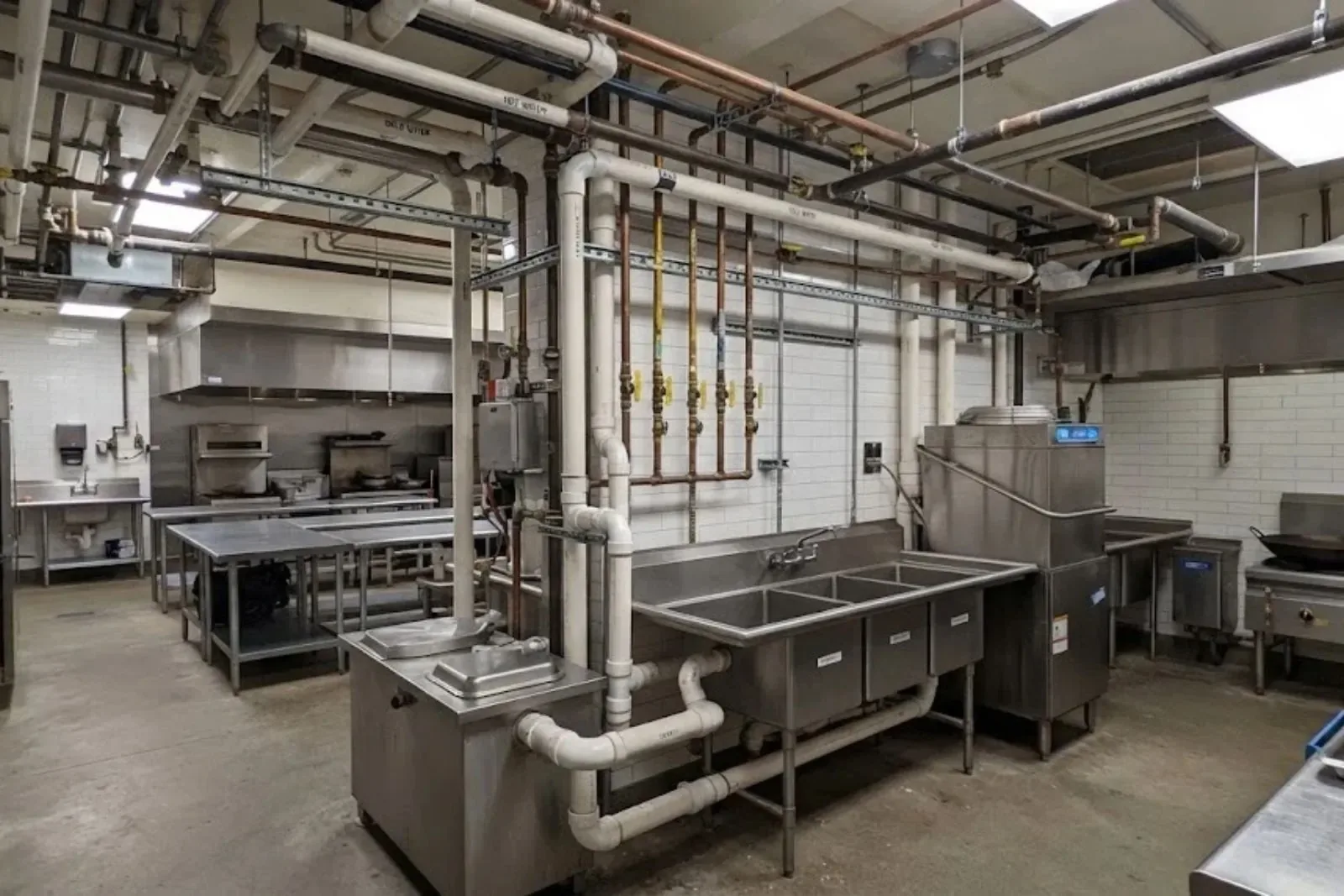
Restroom out, drain backing up, water running: a business emergency.
Commercial plumbing is the same craft as residential work at larger scale. Pipes are longer, fixtures are shared and a failure can close a business for the day. Emergency commercial plumbing in Claremont covers sewer and drain backups, burst or leaking supply lines, failed water heaters, flooded restrooms and kitchen lines that stop during service.
The first minutes matter. Find the shutoff for the affected fixture or section, close it, and keep customers and staff away from wet floors. If sewage is coming up from a floor drain, stop using every restroom and sink. If water is near electrical panels or equipment, leave the area and switch off power only if it is safe.
Then call dispatch. After-hours service is available, so a pipe that lets go at 11 p.m. does not have to wait for opening time.
Shops, offices and restaurants in the Village and along Foothill Blvd.
Claremont's commercial life centers on the Village, the district west of the Claremont Colleges, and on Foothill Boulevard, the main east-west arterial. Indian Hill Boulevard carries north-south traffic past more storefronts. Shops, restaurants and offices there often share buildings and lines with neighbors.
That sharing matters. A clog in a restaurant's kitchen branch can back up into the unit next door, and a ceiling leak can come from the suite above. In any multi-tenant or historic building, such as the Claremont Packing House complex on W 1st St, find out which lines, valves and cleanouts serve only you. Ask the property manager before an emergency, not during one.
Signs your business needs a plumber right away.
- Several fixtures backing up or gurgling at once.
- Water on the floor of a restroom or kitchen that returns after mopping.
- A floor drain that bubbles, smells or lets water rise.
- Sewage odor in the back of house or near the cleanout.
- A stained ceiling or damp wall near a restroom.
- A water heater leaking at the base or no hot water during service.
Restaurants and food service: grease, drains and backflow.
Restaurant kitchens produce grease, starch and food solids that coat drain lines over months. A kitchen branch that slows a little each week is telling you it will stop on a busy night. Cable machines open the line, but for repeat blockages, hydro jetting scours the pipe walls instead of boring a hole through the buildup.
As general trade knowledge, a grease interceptor is a tank that catches fat before it reaches the sewer, and it only works if it is pumped on a regular schedule. A full one lets grease through or backs up the kitchen. Backflow preventers on water supply lines are another common commercial item, usually tested on a schedule. Ask your water provider and the City what applies to your business.
Honest note on commercial leak detection.
A high water bill, a meter that spins when the business is closed, or a damp patch in the slab can mean a leak. In a shared building, the source may belong to another tenant or the landlord. A plumber can isolate sections, test pressure and use acoustic or tracer methods, but the finding is sometimes that the leak is on the other side of your wall. See leak detection for the method.
Business plumbing emergency?.
Licensed plumbers are dispatched around the clock for shops, offices and restaurants.
Landlord, tenant and after-hours coordination.
Before anyone opens a wall, settle who owns the pipe. A lease usually puts the interior fixtures on the tenant and the building systems on the landlord, but leases differ, so read yours. If the problem is a shared sewer line, a roof drain or a riser serving several units, the landlord or property manager often has to authorize the work.
In a true emergency, stopping the damage comes first. A plumber can shut off water, clear what can be cleared and document the cause. That record helps when you and the landlord settle who pays. Keep the property manager's after-hours contact handy.
| Situation. | Likely cause. | Usual response. |
|---|---|---|
| Restaurant kitchen drain stops. | Grease and food buildup in the branch line. | Cable the line, jet if it keeps returning. |
| Restroom backs up in an office. | Paper or wipe clog, or a main blockage. | Auger the fixture, cable the branch or main. |
| Multiple units flood from one pipe. | Shared drain or riser blockage. | Clear the main, notify the landlord. |
| Water heater fails mid-day. | Leaking tank or burner failure. | Isolate the unit, repair or replace. |
| Supply line leak in a ceiling. | Corroded or split pipe. | Shut off the zone, repair the section. |
| Meter spins after hours. | Hidden leak, toilet or irrigation. | Isolate zones, test pressure, trace. |
What happens on an emergency business call.
- 1.
Dispatch and triage.
You describe the problem, and the plumber knows what to bring.
- 2.
Stop the damage.
Shutoffs are located and closed, and standing water is controlled where possible.
- 3.
Diagnose.
Drains are inspected with cables or a camera, and supply lines are pressure tested.
- 4.
Explain the options.
You get the repair choices, the scope and what the landlord needs to approve.
- 5.
Repair and test.
The fix is completed, fixtures are tested and any follow-up work is noted.
What drives commercial plumbing cost.
Size and layout of the system.
A shop with one restroom differs from a restaurant with kitchen lines and multiple fixtures.
Access.
Ceilings, floor drains, rooftops and shared walls change the time needed.
Cause and location of the problem.
A fixture clog is quick, while a main or hidden leak takes more tools and time.
Equipment needed.
Cabling, camera inspection, hydro jetting or pressure testing each add scope.
You get a clear price before work starts, and the plumber will explain any change if something unexpected turns up.
Before the plumber arrives.
Find the shutoff.
Locate the water valve for the affected area and the main for the unit, and have someone close it if safe.
Protect people and goods.
Block off wet floors, move stock and cover equipment.
Get the right contact.
Have the property manager or landlord number ready in case access is needed.
Note what changed.
Write down what was running, which fixtures are affected and when it started.
Know your cleanout before you need it.
A cleanout is the capped access point on a drain line. In a business it may be outside, in a back hallway or in a utility room, and in a shared building it may serve several tenants. Knowing where it is saves time when a plumber arrives. If sewage is backing up, the City of Claremont notes that a private lateral is the owner's responsibility, so confirm with a plumber before calling the City. For a larger line problem, see sewer line cleaning.
Code, permits and licensing for commercial work.
Commercial plumbing falls under the California Plumbing Code, built on the Uniform Plumbing Code (UPC), and tenant improvements often need permits. Call the Claremont Building Division at (909) 399-5477 and verify contractors with the Contractors State License Board.
Commercial plumbing questions.
.
Yes. Dispatch is staffed around the clock, including nights, weekends and holidays. Call and describe the problem, close the nearest shutoff, and keep people away from wet floors. A licensed plumber is sent to restaurants, shops and offices across Claremont and nearby towns.
.
Yes. Repeat kitchen blockages are usually grease and food solids. A plumber can cable the line and, if it returns, recommend hydro jetting and a check of the grease interceptor. A regular cleaning schedule reduces surprises.
.
It depends on your lease and where the problem sits. Fixtures inside your space are often the tenant's, while shared sewer lines, risers and roof drains are often the landlord's. A plumber can document the cause, which helps both sides sort out responsibility.
.
Yes. Claremont is our home area, and that includes shops and restaurants in the Village and along Foothill Boulevard. Shared buildings need extra coordination, so have the property manager's contact ready.
.
It can be, if the meter runs while the business is closed or the bill jumps without explanation. Results vary, because in a shared building the source may be someone else's line. A plumber can tell you what the testing can realistically find.
.
Yes. Dispatch reaches commercial customers across the area, including Pomona. The Pomona plumber page shows what we cover there.