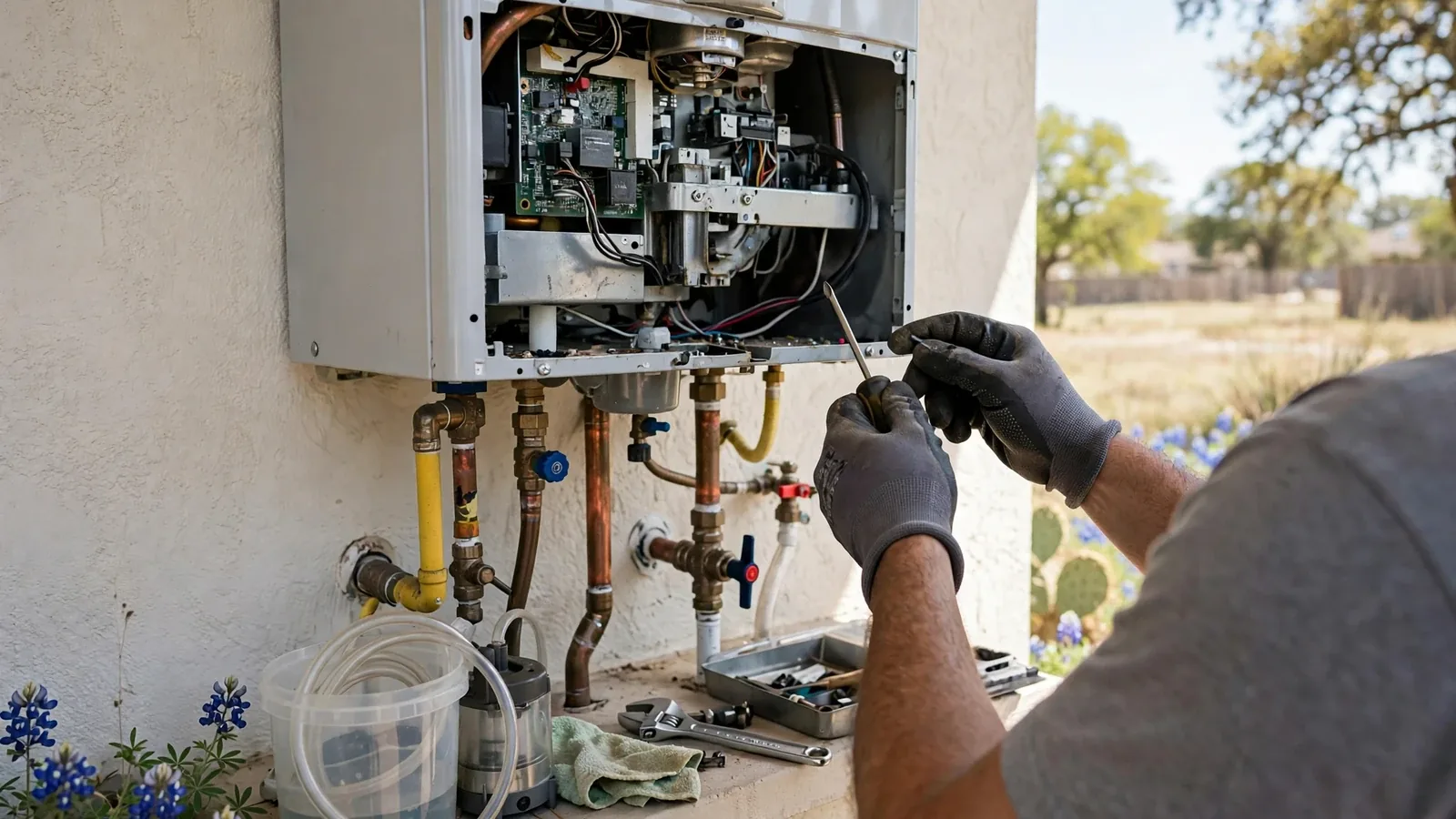
The short answer on tankless water heater cost.
The average cost of a tankless water heater in Claremont is not one number, because the heater is often the smaller part of the job. A tankless unit costs more than a same-capacity tank, and the install around it moves the total more than the brand does. Gas line size, venting, a condensate drain, electrical supply and your hot water demand all push the bill up or down.
A plumber can only give a real price after seeing the old heater, the gas meter run and the wall where the new unit will hang. Below is each factor, what it means, and how to tell whether tankless suits your house at all.
Why the unit price is only the start.
A tankless heater heats water only while a tap is open. Cold water enters a heat exchanger, a gas burner or electric element fires, and hot water leaves at the set temperature. There is no tank to keep warm, which is why people assume the job is simple.
It rarely is. A tankless unit demands a large burst of fuel the second you open a shower. Everything feeding it, including pipe, vent and power, has to handle that burst, and that is where the money goes.
Gas line capacity comes first.
Most homes with an older tank heater have a gas line sized for a modest burner. Many tankless units want a much bigger burner input, so the plumber measures the run from the meter, counts fittings and checks whether the existing pipe can deliver enough volume. If it cannot, a section gets replaced with larger pipe.
This is the most common surprise on a quote. A short, straight run might need nothing. A long run through an attic might need new pipe the whole way.
- Distance from the gas meter to the heater location.
- Other gas appliances sharing the same line, such as a range or dryer.
- Pipe material and diameter now in the wall.
If you smell gas at any point, leave the building, then call SoCalGas at 1-800-427-2200 from a safe place. If life may be in danger, call 911.
Venting and the condensate drain.
Tank heaters usually vent through a single draft hood and a vertical flue. Tankless gas units vent differently. Standard models run hot exhaust through special stainless or plastic vent pipe, often out a side wall, and high-efficiency models produce acidic condensate that must drain somewhere.
That means a wall penetration, vent pipe of the correct material, proper clearances and a neutralizer or a drain path for condensate. Moving the heater from a closet to a garage wall can change this part a lot.
Electrical and controls.
Even a gas tankless heater needs power for its fan, controls and ignition. Some models also want a dedicated outlet, and electric tankless units are a different story. They draw very large current, and many houses do not have spare breaker capacity or heavy enough wiring for one.
If your panel is full or old, that work lands on the quote. Ask whoever bids to say plainly what is included for power.
Want a clear price for your house?.
Dispatch can send a licensed plumber to look at the gas run, vent path and wall space.
How tankless compares with a tank, side by side.
| Item. | Tank heater. | Tankless heater. |
|---|---|---|
| Unit price. | Lower. | Higher. |
| Install work. | Usually a like-for-like swap. | Often gas pipe, vent and drain changes. |
| Hot water supply. | Limited by tank size, then runs cold. | Continuous as long as flow stays within the unit's limit. |
| Standby heat loss. | Some, since the tank stays hot. | Little, since it heats on demand. |
| Floor and wall space. | Needs floor room. | Wall mounted, saves floor space. |
| Maintenance. | Flush sediment, check anode rod. | Descale heat exchanger, clean filter. |
| Typical lifespan. | Shorter. | Often longer with upkeep. |
Tankless removes the running-out problem but costs more to install. A tank costs less up front and is easier to replace, but it can run out during back-to-back showers. Neither is wrong. The right pick depends on your household and your pipes. Homeowners in La Verne and Pomona weigh the same trade-offs.
Flow rate and how many fixtures run at once.
Tankless units are sized by how many gallons per minute they can raise to a set temperature. A shower might use a couple of gallons per minute, a dishwasher and washing machine add more, and a rise from cold inlet water to a hot setting is a bigger job in winter than summer.
If two showers and a laundry load run together, a single small unit may struggle. Larger units or two units cost more. A good plumber asks how many people live in the house and when the busiest hour is, then sizes the heater to that, not to the cheapest model.
Hard water changes the long-term cost.
Scale is the quiet cost of tankless. Minerals in hard water build up inside the heat exchanger, narrow the passages and make the heater work harder. Left alone, a unit can lose efficiency, throw error codes or fail early. Homes with hard water often add a scale inhibitor or water softener, plus a yearly descaling flush.
Local note
Claremont water hardness and your tankless plan.
Golden State Water Company's 2026 Annual Water Quality Report for the Claremont Water System, based on 2025 data, lists hardness as calcium carbonate from 97 to 330 milligrams per liter, with an average of 190. In grains per gallon, that is a range of 5.7 to 19 and an average of 11.
That spread is wide. Your tap may sit near the soft end or the hard end depending on which wells and imported water feed your street at the time. Ask Golden State Water Company at its 24-hour line, 1-800-999-4033, what applies to your address, then budget for descaling and consider a scale inhibitor in the plan.
Who tankless suits, and who it does not.
Tankless suits people who are staying put, run a busy household or want floor space back. It suits people less when the gas run is long and undersized, venting would mean cutting through a finished wall, or the house has little budget for the extra work.
Many homeowners compare both quotes side by side before deciding. If you want a real look at the options, our tankless water heater service covers the evaluation, and the water heater installation team can quote a tank swap next to it.
Earthquake strapping and permits.
California Health and Safety Code section 19211 requires new and replacement water heaters to be braced, anchored or strapped against falling or horizontal movement in an earthquake. It applies to heaters up to 120 gallons that have a pre-engineered strapping kit available.
Permit rules for a specific job are a question for the city, not a guess. Call the Claremont Building Division at (909) 399-5477 and describe the work before you hire anyone.
What to ask before you accept a quote.
Two quotes for the same heater can differ because the scope differs. Ask each contractor the same questions.
- Is the gas line upgrade included, and what size is the new pipe?.
- What vent material and route are planned, and who patches the wall?.
- What is included for electrical and for an expansion tank or relief valve?.
- How is hard water handled, and what maintenance should I plan?.
You can also check a contractor's license and complaint history at the California Contractors State License Board website. The C-36 plumbing classification covers water heating equipment.
Standards that drive tankless cost.
Gas line sizing, venting and electrical needs for tankless heaters are set by the California Plumbing Code, built on the Uniform Plumbing Code (UPC), and by the manufacturer's manual. Those requirements are why quotes vary.
Tankless water heater cost questions.
.
The unit itself costs more, and the install usually needs extra work. Gas pipe may need upsizing, venting changes through a wall or roof, a condensate drain and sometimes electrical updates. A tank swap often reuses existing connections, so it costs less in labor and parts.
.
It can. Golden State Water Company reports average hardness near 190 milligrams per liter, and scale builds inside the heat exchanger over time. Yearly descaling and a scale inhibitor or softener help protect the unit, so factor that upkeep into the long-term cost.
.
Sometimes. The existing gas and water connections are a start, but the vent route and clearances are different. A plumber needs to look at the closet or garage wall. For help sizing it, our water heater installation page explains how a visit works.
.
Maybe, maybe not. Tankless burners demand more fuel at once, so the plumber measures pipe diameter, length and fittings. If the line is undersized, part of it gets replaced with larger pipe. That is one of the biggest drivers of the final cost.
.
Ask the Claremont Building Division at (909) 399-5477. The city says plumbing and water heater work should be confirmed with the Building Division, and the answer depends on the job. A licensed plumber can also tell you what applies.
.
It depends on your timeline and the quote. A tankless heater can appeal to buyers, but the extra install cost may not come back quickly. If you will sell within a few years, many people lean toward a simpler tank replacement.