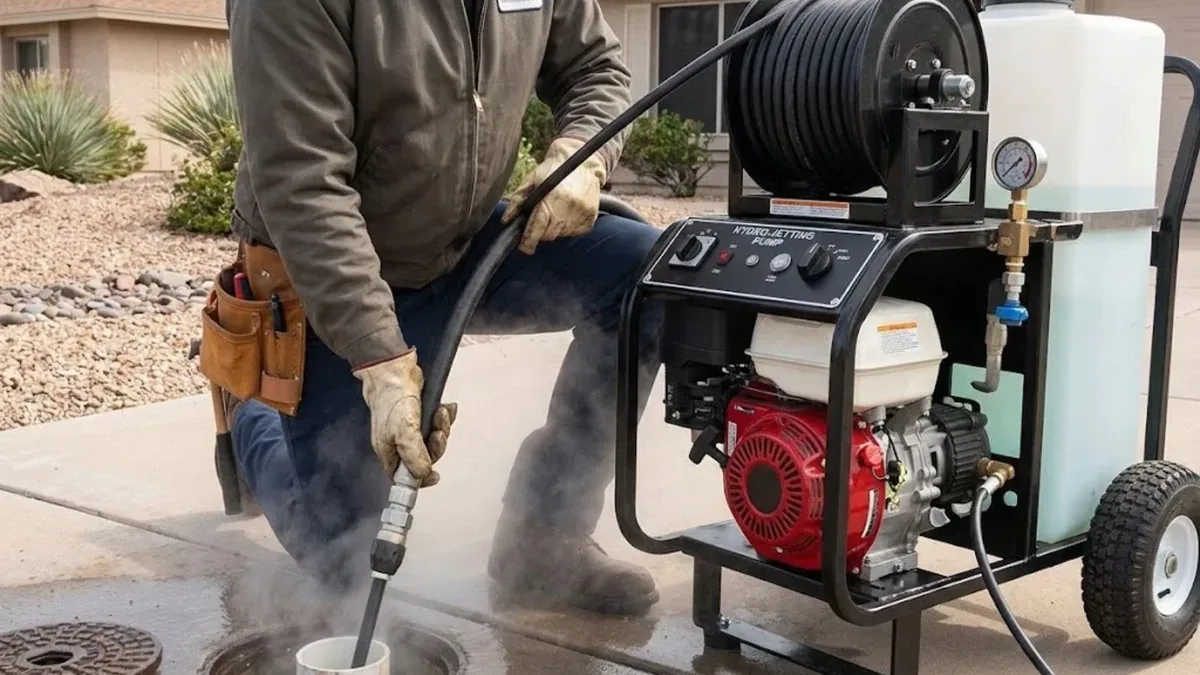
What jet cleaning does to a sewer line.
Jet cleaning sewer lines means feeding a flexible hose with a specialized nozzle into the pipe and blasting water at high pressure. The nozzle has rear-facing jets that pull it forward and spin water against the pipe wall. Grease, scale, silt and chopped-up roots get scoured loose and washed downstream.
A drain snake, or cable machine, works differently. It bores a hole through the blockage so water can pass, but it often leaves a coating of material on the pipe wall. That coating is the reason some clogs return in a few months.
Jetting versus snaking in plain terms.
Both tools have a place. A snake is quick, cheap to run and fine for a fresh clog like a hairball or a toy. Jetting takes more equipment and time, and it is the better choice for grease, roots and layered buildup.
| Question. | Cable snake. | Hydro jetting. |
|---|---|---|
| What it does. | Pokes a channel through the clog. | Scours the full pipe wall. |
| Best for. | Single soft clogs, quick relief. | Grease, roots, scale, repeat blockages. |
| Leaves residue. | Often. | Usually little. |
| Pipe condition needed. | Tolerant of most pipe. | Needs sound, intact pipe. |
| Typical result. | Flow returns, clog may recur. | Pipe walls cleaned out. |
| Trade-off. | May not last. | More equipment, not for fragile pipe. |
Jetting cleans more thoroughly but is not for every pipe. That caveat is the main reason a reputable plumber will look inside first.
Camera first, always.
Before any high-pressure work, a plumber should run a sewer camera. It is a small waterproof lens on a flexible rod that shows the inside of the pipe on a screen. The camera reveals what is blocking the line and, more important, what shape the pipe is in.
- Roots entering at joints.
- Grease collars or scale narrowing the bore.
- A bellied section holding water.
- Cracks, offset joints or collapsed sections.
- Where the lateral meets the main.
If the camera shows a broken pipe, jetting can make it worse by washing out the soil around the break. In that case, the fix is a repair, not a cleaning.
What jetting clears best.
Two things cause most sewer line trouble: grease and roots. They behave differently and both respond to jetting.
Grease and kitchen buildup.
Grease from cooking cools in the pipe and sticks to the wall as a waxy layer. Over months it narrows the bore until a clog forms. Hot-water flushes do not remove it because the grease just moves down the line and hardens again. A jetter with the right nozzle shaves it off.
Roots in older lines.
Fine roots enter through joints looking for water. They grow into thick mats that trap paper and waste. A jet with a cutting nozzle can clear roots, but they will regrow if the joint stays open. Repeat visits on a schedule, or repairs to the joint, are the long-term answer.
Sewer line slow again?.
Dispatch can send a licensed plumber to camera the line and decide between snaking and jetting.
Which pipes should not be jetted.
Jetting is not a cure-all. Some pipes cannot take the pressure, and some conditions make it risky. A good plumber says no when it is the wrong tool.
- Pipe that is cracked, collapsed or separated at a joint.
- Severely corroded old cast iron that flakes when touched.
- Lightweight fiber pipe or other material that has softened with age.
- Lines with a damaged or poorly bonded repair or lining.
- Fixtures or drains with no clean-out for safe access.
For these, the plumber may recommend snaking at lower force, spot repair or replacement. Camera footage helps you see the reason.
What happens during a jetting visit.
A typical jetting visit.
- 1.
Find access.
The plumber locates a clean-out or removes a toilet to reach the line.
- 2.
Camera the pipe.
The camera shows the blockage, pipe material and condition.
- 3.
Choose the nozzle.
A penetrating nozzle opens the clog, then a scouring or cutting nozzle cleans the walls.
- 4.
Jet in passes.
The hose is pushed in and pulled back while water runs, so debris flows toward the main.
- 5.
Re-camera and confirm.
A final camera run checks that the pipe is clear, and the plumber notes any damage.
Claremont lateral ownership and pipe makeup.
Knowing whose pipe you are cleaning matters, because the answer decides who pays and who repairs.
Local note
Claremont's sewer system and your lateral.
The City of Claremont's sewer page says the City owns and operates the sanitary sewer, with about 122 miles of gravity sewer. Pipe materials in the system include vitrified clay, PVC, asbestos cement, ABS, reinforced concrete and cured-in-place lining, and the mains range from 8 to 15 inches.
The City says property owners are responsible for the private lateral from the house to the City main, usually in the middle of the street. It does not respond to problems inside a private lateral, so verify the lateral with a plumber first. The Engineering Division at (909) 399-5465 can help locate it.
That mix of materials is why a camera matters. Your lateral may be a different material from the main it joins, and it may be older than the house's other plumbing. Our sewer line cleaning page explains the camera work that comes before any cleaning.
What drives the cost of jetting.
Without a figure to quote, the factors are what you can compare between companies.
- How long the line is and how easy it is to reach.
- Whether a clean-out already exists or must be created.
- How severe the roots or grease are.
- Whether camera inspection is included.
- Equipment size needed for the pipe diameter.
- Whether the visit is during regular hours or an emergency call.
A clear price before work starts is the normal standard. Ask what the quote covers and whether a follow-up camera run is part of it.
Keeping the line clear afterward.
A clean pipe stays clean longer if what goes into it changes. The City of Claremont advises flushing only toilet paper, since wipes, paper towels and feminine products cause blockages that cost more in older pipes. Keep grease out of the kitchen drain, too, and think about trimming roots or planting away from the lateral path.
Neighbors in Montclair and La Verne deal with the same habits, even though each city has its own sewer system and rules.
Standards and verification.
Jetting is a maintenance method, and repairs that follow it must meet the California Plumbing Code, built on the Uniform Plumbing Code (UPC). Use the Contractors State License Board's Check a License tool before authorizing work.
Jet cleaning sewer line questions.
.
For grease, roots and repeat clogs, usually yes, because it scours the pipe wall instead of poking a hole. For a single soft clog, a snake is often enough. A camera inspection tells the plumber which is right.
.
On sound pipe it is safe when done with the right nozzle and pressure. On cracked, collapsed or badly corroded pipe it can do harm. That is why a camera goes in first and why some lines should be snaked or repaired instead.
.
No. It clears roots from inside the pipe, but they grow back if the joint stays open. Many homeowners schedule periodic cleaning or fix the entry point. Our hydro jetting service can cut roots and the plumber will point out where they enter.
.
Based on the City of Claremont, the owner is responsible for the private lateral from the house to the main, and the City does not respond to problems inside it. Verify with a plumber first. If the main is blocked, call Community Services.
.
If the clog came on suddenly, a snake may be enough. If slow drains return every few months, or the camera shows grease and roots on the walls, jetting is the better answer.
.
It depends on the pipe, not the age of the house. Sound clay, PVC or cast iron can often be jetted. Damaged or fragile sections cannot. The camera shows the material and condition before any high-pressure work begins.