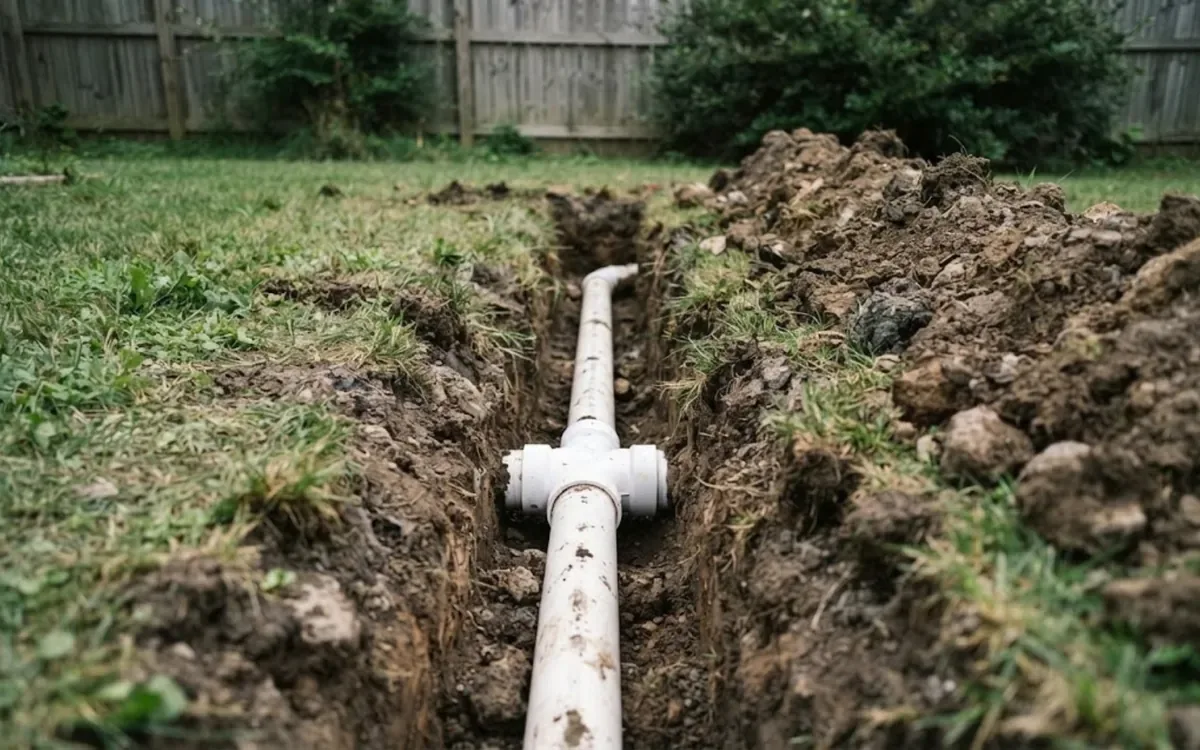
What a service line is and when it needs replacing.
A water service line is the underground pipe between the utility's meter and the point where water enters your house. Replacement makes sense when the pipe has failed in more than one spot, has corroded or thinned with age, or has been damaged by roots, digging or soil movement. A single clean break can often be repaired, but a pipe that keeps leaking should be replaced.
In California, a plumber licensed in the C-36 classification can work on water and gas service lines from the meter on the owner's side to the structure. That is the stretch this post is about.
Know where your responsibility begins.
Property lines and pipe ownership do not always match, so it helps to know the boundary before something breaks. Golden State Water Company says on its FAQ that it maintains lines up to the water meter. Anything past the meter is the property owner's to fix.
In practice, a pipe that fails on the house side of the meter costs you the repair, even though the line may run under the public right of way for part of its path. If the leak is at or before the meter, call the utility. If it is after the meter, call a plumber. When you cannot tell where the break sits, a plumber can find out.
Local note
Claremont: the meter is the line between utility and owner.
Golden State Water Company operates the Claremont Water System. Its FAQ states that the company maintains lines up to the water meter and that leaks beyond the meter are the property owner's responsibility.
For an owner, that means the buried service line from the meter to the house sits on your side. A failed section there is repaired or replaced at the owner's cost, and the utility will not do it for you.
The company's 24-hour Customer Service Center is 1-800-999-4033, or 909-394-2272 locally. Call it if the trouble is at the meter or on the street side.
How a failing service line shows itself.
Service lines fail quietly, then suddenly. Early signs are subtle: a lawn patch that stays soggy, a driveway crack that stays damp, or a hiss near the front wall. Later, pressure sags in the shower and the washing machine fills slowly.
Signs the buried line may be failing.
- Water pressure has fallen at every fixture, not just one.
- A wet or sunken patch of ground between the meter and the house.
- A water bill that climbs with no change in use.
- Muddy, rust-colored or gritty water when you first open a tap.
- Faucets that sputter or spit air.
- The sound of running water when everything is off.
- Dirt or water pooling around the foundation or in the meter box.
Many of these symptoms overlap with a leak inside the house, so the first move is to isolate the line. A plumber closes the house main and sees whether the problem persists, and then pressure tests the line on its own. That is the logic behind leak detection work on buried pipe, where acoustic gear and locators mark the break before anyone picks up a shovel.
Why old service lines wear out.
Pipe material tells you a lot about likely trouble. Galvanized steel rusts from the inside and chokes down over decades, so pressure fades long before it leaks. Copper can develop pinholes where soil is aggressive. Polyethylene and PEX are flexible and resist corrosion, but they can be damaged by rocks or roots.
Soil movement is another factor. Pipe that runs under a driveway, a patio or a mature tree has little room to flex. Construction nearby, a heavy truck, or a previous repair done badly can stress a line that has been fine for years.
Repair, spot fix or replace: how to decide.
A short repair works when the pipe is otherwise sound and the break is a one-off. Think of a gouge from a shovel or a failed coupling. A longer repair or full replacement is better when the pipe is brittle, has several leaks, or has lost flow capacity from internal buildup.
| Option. | Best for. | Trade-off. |
|---|---|---|
| Spot repair. | One clean break in sound pipe. | Cheapest, but leaves old pipe behind. |
| Open trench replacement. | Old, leaking or undersized lines. | Most dependable, more digging and restoration. |
| Pipe bursting or pulling. | Lines with limited surface access. | Less surface damage, needs entry and exit pits. |
| Rerouting. | Lines under slabs or structures. | Avoids the bad run, new path needs planning. |
A plumber will explain which fits your yard. Trenching through lawn is easy to patch, while a line under a driveway or planter asks for more planning. Landscaping, concrete and fencing all matter to the final scope.
Low pressure and the service line.
Low pressure is the symptom people notice first. A thick line that has scaled up or partly collapsed may deliver only a trickle at the house, even though the meter spins normally. Before assuming the line is bad, a plumber checks the pressure regulator, the main shutoff valve, and fixtures that may have clogged aerators.
If the regulator is fine and the main is fully open, the line itself is the next suspect. Testing the static pressure at a hose bib, then the flow, tells a plumber whether the pipe is restricting water.
Pressure dropping or ground wet?.
Call dispatch and a licensed plumber can locate the failing line and explain the options.
When the whole house plumbing is aging too.
Sometimes the service line is only the first piece of a bigger story. If your home has older galvanized or failing copper inside the walls, replacing the line alone can leave you with new pipe feeding old pipe. That is a good moment to discuss repiping and whether it makes sense to coordinate the two jobs, since the trench and the wall work can share planning.
On the other hand, if the interior pipe tests fine, there is no reason to replace it. A good plumber will show you pressure readings and flow before suggesting more work.
What affects the price.
A service line job is priced by what it takes to reach and replace the pipe. Length of the run is the largest factor, followed by depth, what sits on top of the line, and the pipe material. Soil conditions, access for equipment, and the need to restore lawn, concrete or pavers all add to the total.
Other items to expect on a written scope are shutoff and reconnection at the meter side, pressure testing before backfill, and any inspection your city requires. Ask for each of these to be listed so you can compare more than one scope.
Permits and who to ask.
Rules for replacing a water service line depend on the work. Ask the Claremont Building Division at (909) 399-5477 if your project needs a permit or inspection, and say if the work is a repair or a full replacement. A licensed plumber can tell you what is typical, but the Building Division gives the answer.
If your home is just across the city line, the process is different. Check with the building office in Pomona or Montclair, where the water provider and permitting office are not the same ones.
Taking care of the new line.
After a replacement, watch the meter for a few days with everything off and look for damp spots along the route. Keep heavy equipment and new trees away from the trench. If you plan landscaping or a fence, mark where the line runs so the next contractor does not hit it.
It also helps to know where your main shutoff is and that it moves freely. A valve that has not been turned in years may leak or seize when you need it most. A plumber can replace a worn main valve while the line is open, and that small step saves a lot of grief later.
Standards and who to verify with.
Service line work from the meter to the house falls under the California Plumbing Code, built on the Uniform Plumbing Code (UPC), and the C-36 plumbing classification covers it. Confirm the contractor with the Contractors State License Board.
Questions about water service line replacement.
.
Per Golden State Water Company's FAQ, the utility maintains lines up to the meter and the property owner is responsible for leaks beyond the meter. A buried line between the meter and your house is yours to repair or replace. Call the utility if the leak is at the meter itself or on the street side.
.
Close the house main valve and see if the problem continues. If a meter reading or sound still shows water moving, the leak is outside the valve, usually in the buried line. A plumber can confirm with pressure testing and listening gear before any digging.
.
It depends on the material, soil and how the pipe was installed. Galvanized steel often wears out first, while copper and plastic last longer in friendly ground. Age alone is not proof of failure, so test the line before replacing it.
.
Open trench replacement does disturb the ground along the route, though a plumber can plan it to avoid mature trees and slabs. Methods that pull a new pipe through the old path reduce digging but need access pits at each end. Ask which method fits your lot.
.
This page cannot answer that, because permit rules depend on the job. Ask the Claremont Building Division at (909) 399-5477 before work begins and describe the pipe, the length and where it runs.