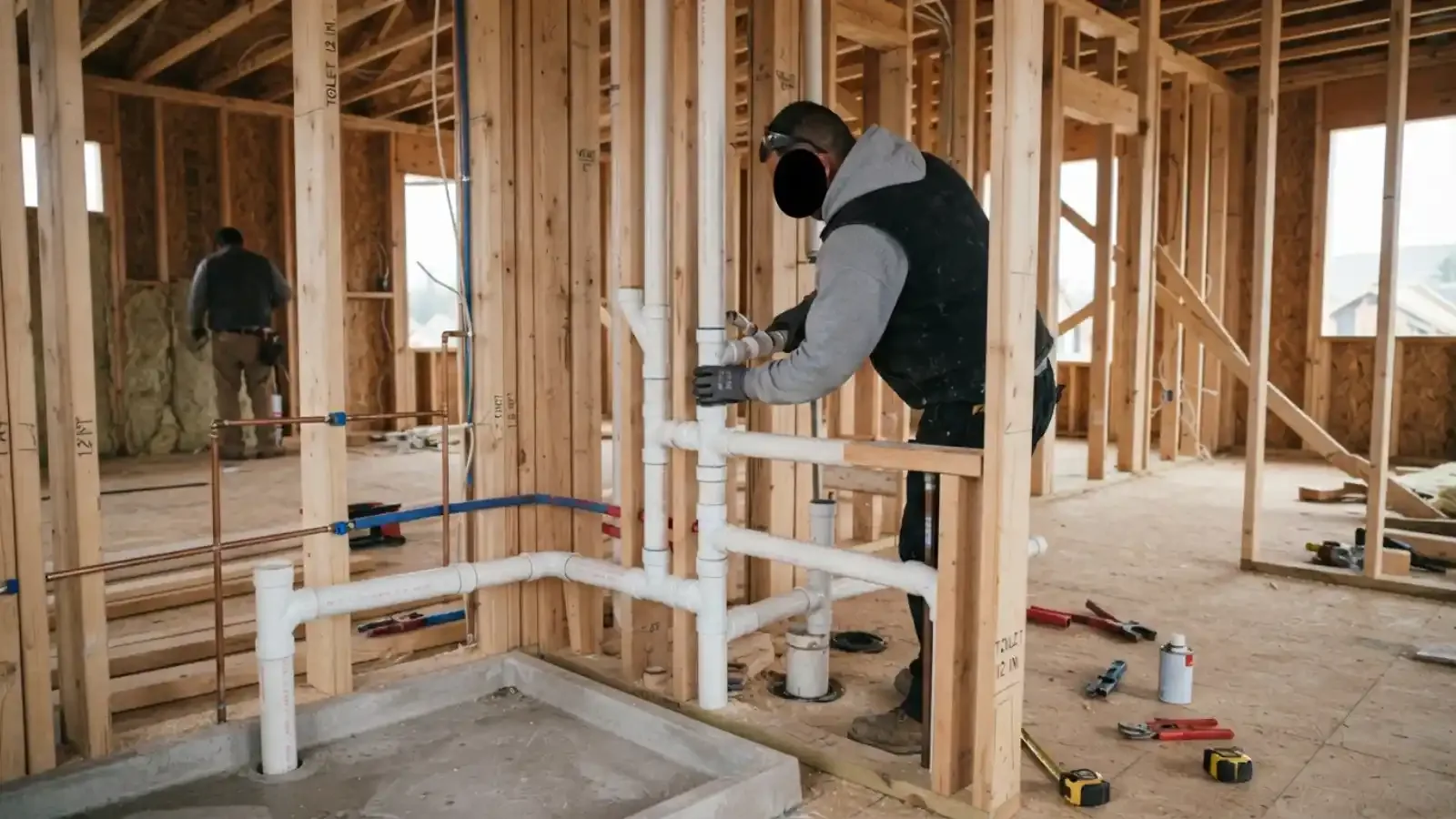
Four plastics, four jobs.
Plastic plumbing pipe falls into two families. Drain, waste and vent lines carry gravity flow and use PVC or ABS. Pressurized supply lines for hot and cold water use CPVC or PEX. Fittings are the elbows, tees, couplings and adapters that join each one, and they must match the pipe they connect.
The most common mistake is grabbing whatever fits the diameter. A fitting that slides on is not necessarily one that will hold, and a joint made with the wrong cement or tool can seep for months before it fails.
Start by reading the color and the printing.
Every plastic pipe is marked along its length with the material, size and a schedule or pressure class. Color helps, but print is the proof.
- PVC is usually white. Schedule 40 PVC is common for drains and vents..
- ABS is black or dark gray and is also used for drains and vents..
- CPVC is cream or tan and is rated for hot and cold supply water..
- PEX is flexible tubing, often red, blue or white, with fittings of brass or polymer..
If the marking has worn away, a plumber will look at the wall thickness, the cement residue and where the pipe sits in the system before cutting anything.
What each one does in a home.
PVC drain and vent fittings.
These are socket fittings: pipe slides in, cement fuses the surfaces. Common pieces include sanitary tees, wyes, long-sweep elbows, closet flanges and clean-out adapters. Drain fittings are shaped to keep waste moving downhill, which is why a plain pressure-style tee will not substitute for a sanitary tee on a drain.
ABS drain and vent fittings.
ABS works the same way with a different cement. It tolerates cold better and many builders prefer it for its quick set. In a given house you may find ABS in one addition and PVC in another.
CPVC for hot and cold supply.
CPVC takes higher temperatures than PVC, so it is used for water that has to stay pressurized and warm. Fittings are socket-style, glued with CPVC cement and, depending on the job, a primer. It is rigid and can become brittle with age, which matters in older remodels.
PEX for supply lines.
PEX is flexible tubing joined by crimp rings, cinch clamps or expansion rings. It bends around obstacles, which cuts the number of fittings, and a repipe can often run it through walls with fewer openings. Fittings are brass or polymer pieces pressed on with a calibrated tool.
Why you cannot freely mix them.
This is the heart of the topic.
| Pairing. | Safe?. | What it takes. |
|---|---|---|
| PVC to PVC. | Yes. | PVC primer and cement. |
| ABS to ABS. | Yes. | ABS cement. |
| PVC to ABS. | Only with care. | Transition cement or a rubber coupling. |
| CPVC to CPVC. | Yes. | CPVC cement. |
| CPVC to PVC. | Not for pressure. | Use a proper adapter, not drain parts. |
| PEX to PEX. | Yes. | Crimp, clamp or expansion fitting. |
| PEX to CPVC or copper. | Yes. | Transition fitting made for both. |
Solvent cement works by softening the pipe surface and welding two pieces of the same plastic together. Different plastics do not weld the same way, so a joint can look good and fail under pressure or a thermal swing. Many plumbers use a shielded rubber coupling for a mixed drain joint because it does not depend on chemistry.
Solvent cement versus crimp rings.
Solvent-welded joints need attention to detail. The pipe is cut square, the burrs are removed, the surfaces are cleaned and primed, cement goes on both parts and the pipe is twisted into the socket. Then it needs cure time before pressure or full flow. Skipping the primer on a pressure joint, or testing too early, is how leaks start.
A crimp or clamp joint on PEX relies on a tool and a go/no-go gauge. The pipe goes over a barbed fitting and a copper ring is squeezed down. No glue, no cure time, but a wrong ring size or an off-center crimp can weep. That is why a plumber measures every crimp.
Not sure which pipe is behind your wall?.
Call the dispatcher and a licensed plumber can tell you what you have and what to use.
Quick sizing and layout notes.
Pipe size is nominal, and the outside diameter of drain pipe does not equal the number printed on it. A fitting for one inch will not fit three-quarter. Drain pipe needs a gentle downward slope and a vent, while supply pipe does not slope but should be supported at regular intervals so it does not sag or hammer.
Expansion matters too. Hot supply lines grow when heated and shrink when cool. CPVC and PEX should be allowed to move slightly, and rigid straps used too tightly can create noise and wear points.
Where a homeowner can help, and where not to.
Replacing a fixture's flexible supply connector, swapping a slip-joint trap or adding a threaded fitting with thread tape are normal weekend jobs. Cutting into a drain stack, extending a branch line or changing supply materials is another category.
Mixed materials are a particular trouble spot in older houses that have been remodeled several times. A previous owner may have connected copper, galvanized and plastic with the wrong adapters. When you plan a remodel, a plumber doing plumbing installation will check what the existing lines are before adding to them.
When plastic points toward a larger project.
If a house has lines that are scaling up, leaking at joints or failing in several places, patching fittings stops making sense. A whole-house repiping job replaces supply lines with a single material and fewer joints. In many cases that means PEX, though the right choice depends on the house, your water, and what the plumber finds in the walls.
Ask these questions before agreeing to a pipe change:
- What material is being removed, and what is replacing it?.
- Which fittings and which joining method will be used?.
- How will old and new sections be connected?.
- Who handles wall and ceiling repair?.
- Does the local Building Division need to be contacted?.
What affects the price of a fitting or pipe job.
The cost of a fitting itself is small. Labor, access and scope drive the total.
- How many joints and how far the pipe runs.
- Whether walls or ceilings must be opened.
- Pipe type and the specialty tools needed.
- Pressure testing and inspection steps.
- Mixed-material transitions that need special couplings.
Local note for Claremont.
Local note
What the City of Claremont's sewer system is made of.
The City of Claremont owns and operates the sanitary sewer, about 122 miles of gravity sewer, according to the city's sewer page. That page lists the pipe materials in the system as vitrified clay, PVC, asbestos cement, ABS, reinforced concrete and cured-in-place lining, with mains from 8 to 15 inches.
Property owners are responsible for the private lateral that runs from the house to the city main, usually in the middle of the street. The city also advises flushing only toilet paper, because blockages cost more in older pipe. If a drain backs up, a plumber should confirm the problem is in your lateral before you call the city.
Why the code matters here.
Which plastic pipe and fittings are allowed where is set by the California Plumbing Code, built on the Uniform Plumbing Code (UPC), and by the pipe manufacturer's instructions. When in doubt, ask a licensed plumber before gluing anything together.
Plastic pipe questions.
.
Standard PVC cement or ABS cement alone is not recommended for that joint. A transition cement made for both, or a shielded rubber coupling, is the safer route. Have a plumber make the connection where the drain is buried or inside a wall.
.
Both are used. CPVC is rigid and glued, PEX is flexible and crimped. PEX usually needs fewer fittings and is easier to route, while CPVC suits straightforward runs. The right choice depends on the house, existing pipe and the plumber's experience.
.
Follow the cement label, because cure time depends on pipe size, temperature and whether the joint carries pressure. Pressure lines need longer than drains. A plumber also pressure-tests new supply work before closing walls.
.
The City of Claremont says its sewer system includes vitrified clay, PVC, asbestos cement, ABS and reinforced concrete pipe, plus cured-in-place lining. Your private lateral may be a different material from the main it connects to.