Why nobody can name a price over the phone.
The honest answer to what a hot water heater repair costs is that it depends on the diagnosis. A thermostat swap on an electric tank is a short job. A leaking tank is not a repair at all, because the steel shell cannot be patched. Two heaters with the same complaint, no hot water, can need very different work.
So this page does not list figures. It lists what moves the price up or down, and a way to decide between fixing and replacing. Use it to ask better questions when a plumber quotes you.
The six cost factors, ranked by how much they move the bill.
1. Which part failed.
Cheap parts include a thermocouple, a pilot assembly, a thermostat and a drain valve. Mid-range parts include a heating element, a T&P relief valve or an igniter. Expensive parts include a gas control valve, and a leaking tank itself, which means replacement.
2. Gas or electric.
A gas tank has a burner, a flue and a gas control valve, so more things can fail and the work involves combustion safety. An electric tank has two elements and two thermostats, which makes diagnosis simple with a meter. Parts and labor differ between the two.
3. Access and location.
A heater in a garage with open floor space is the easy case. One in a tight closet, an attic or over a finished ceiling takes longer to work on, and a plumber may need to disconnect and pull it out to reach a part.
4. Age and condition.
An older tank often has corroded fittings that snap, seized nipples, and a drain valve that will not turn. Repair labor grows when everything around the failed part is stuck.
5. Sediment and scale.
A tank loaded with sediment can block the drain, bury the lower element or overheat the tank bottom. A flush may be part of the visit, or a reason to stop repairing.
6. Code and safety items that come along.
Strapping, a working relief valve and discharge pipe, proper venting on a gas unit and a shutoff within reach are all checked. If something is missing, bringing it up to standard adds to the job.
Symptom to part to likely path.
| Symptom. | Likely cause. | Usual direction. |
|---|---|---|
| No hot water, electric. | Tripped reset, bad element or thermostat. | Repair. |
| No hot water, gas. | Pilot out, thermocouple or gas valve. | Repair, unless unit is old. |
| Warm but not hot. | One element failed or sediment. | Repair or flush. |
| Popping or rumbling. | Sediment hardened on the bottom. | Flush, or replace if severe. |
| Water at the base. | Fitting, valve or the tank shell. | Check first, tank leak means replace. |
| Rust-colored hot water. | Corroded tank or anode depleted. | Evaluate for replacement. |
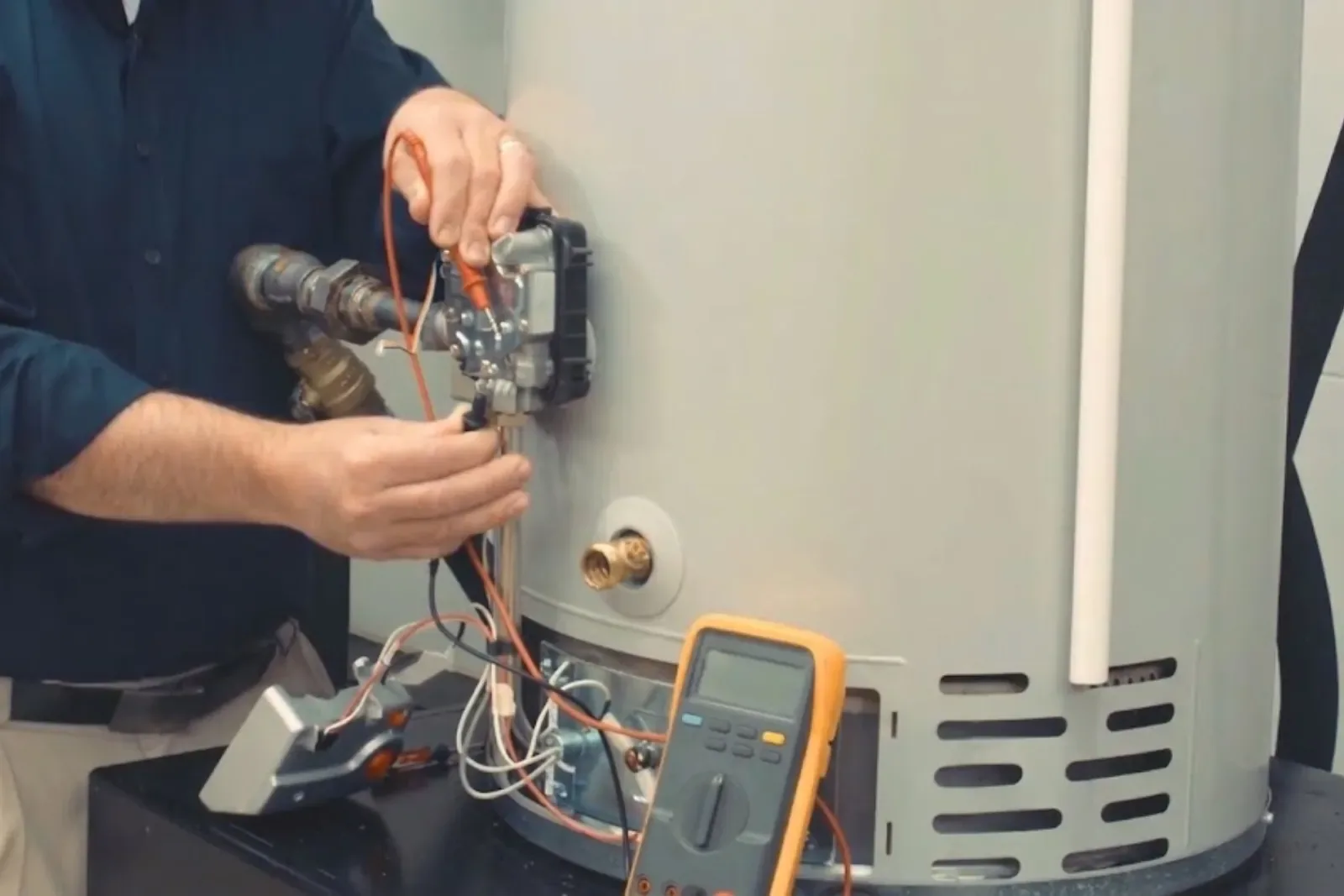
A plumber working through this table does not guess. On an electric heater the tech measures voltage and element resistance. On gas, the tech checks the pilot flame, the thermocouple output and the burner assembly, and looks at venting and combustion air.
How to decide between repairing and replacing.
Use a frame, not a hunch. Three questions get you most of the way.
- How old is the tank? Most tank water heaters are built to last roughly a decade, a bit more or less depending on use and water. The serial number on the label tells the manufacture date..
- Is the tank itself leaking? Water coming out of the shell means the liner has failed. Replace..
- Is the repair a large share of replacement? If a single repair approaches half of what a new unit costs and the tank is already past middle age, putting money into the old one often loses..
A newer heater with a failed element or thermostat is an easy repair call. An old heater that needs a gas control valve plus a flush, plus a new relief valve, tips toward new. When a plumber recommends the second path, ask to see the failed part or the leak so you understand why.
Our water heater repair visits start with diagnosis for exactly that reason, and a water heater replacement quote can sit next to it so you can compare.
Heater leaking at the base?.
Shut off the water and power or gas supply if you can do it safely, then call for same-day help when available.
The part you do not see on the invoice.
Some of what you pay covers work that is easy to overlook. Draining the tank, protecting the floor, hauling off a failed part, testing for leaks after reassembly, and checking that the temperature and pressure relief valve discharges to a safe place are all part of a proper visit.
Safety matters more than speed. On gas units, a plumber confirms the flame is stable, the draft pulls exhaust outside and there is no gas odor. If you ever smell gas, leave the building, call SoCalGas at 1-800-427-2200 from a safe place, and call 911 if life may be in danger. Do not try to relight a pilot while you smell it.
How hard water pushes the cost up.
Mineral scale does not announce itself. It coats elements, clogs the bottom of the tank and wears the anode rod down faster. The result is longer recovery times, noisy operation and earlier part failure. A plumber who sees heavy scale on a removed element can tell you the unit has been working harder than it should.
That is why a flush and anode inspection can save money on the next repair. A heater with decent maintenance usually has simpler repairs than one that has never been drained.
Ways to keep the bill smaller.
- Describe the symptom precisely: no heat, weak heat, noise, leak, odor..
- Know the age. Take a look at the label before the call..
- Clear the area around the unit so the plumber can reach it..
- Ask for the fix and the replacement option in the same visit..
- Flush the tank on a schedule your plumber suggests..
Local note for Claremont.
Local note
Claremont water, permits and licensed help.
Golden State Water Company's 2026 Annual Water Quality Report, based on 2025 data, lists Claremont hardness from 97 to 330 mg/L as calcium carbonate, with an average of 190 mg/L. That is about 11 grains per gallon on average, and it ranges from 5.7 to 19. Water in that range leaves scale on elements and tank bottoms over time.
For permits on a water heater job, the City of Claremont tells residents to call its Building Division to confirm, and the Building Official can be reached at (909) 399-5477. The California Contractors State License Board also lets you check a plumber's license and complaint disclosure at cslb.ca.gov before you hire.
Standards behind the repair.
Repairs to relief valves, venting and gas connections fall under the California Plumbing Code, built on the Uniform Plumbing Code (UPC). Before approving any quote, you can check the plumber's license on the Contractors State License Board site.
Water heater repair cost questions.
.
Parts quality, diagnosis time, access, and whether the quote includes extras like a flush or a new relief valve all vary. Ask what is included, which part is being replaced, and whether the quote assumes the tank is otherwise sound.
.
Sometimes. If the tank is dry, the fitting is sound and the repair is small, it can buy several more years. If the tank leaks, rusts or needs a large part, replacement usually makes more sense because every other component is aging too.
.
Often yes, because gas units have a burner, flue and control valve, and the work includes combustion and venting checks. Electric repairs are usually simpler, but you still pay for diagnosis, parts and the time to drain the tank.
.
The city says to call its Building Division to confirm for plumbing and water heater jobs, and the Building Official's line is (909) 399-5477. Do not assume either way, because the answer depends on the work being done.