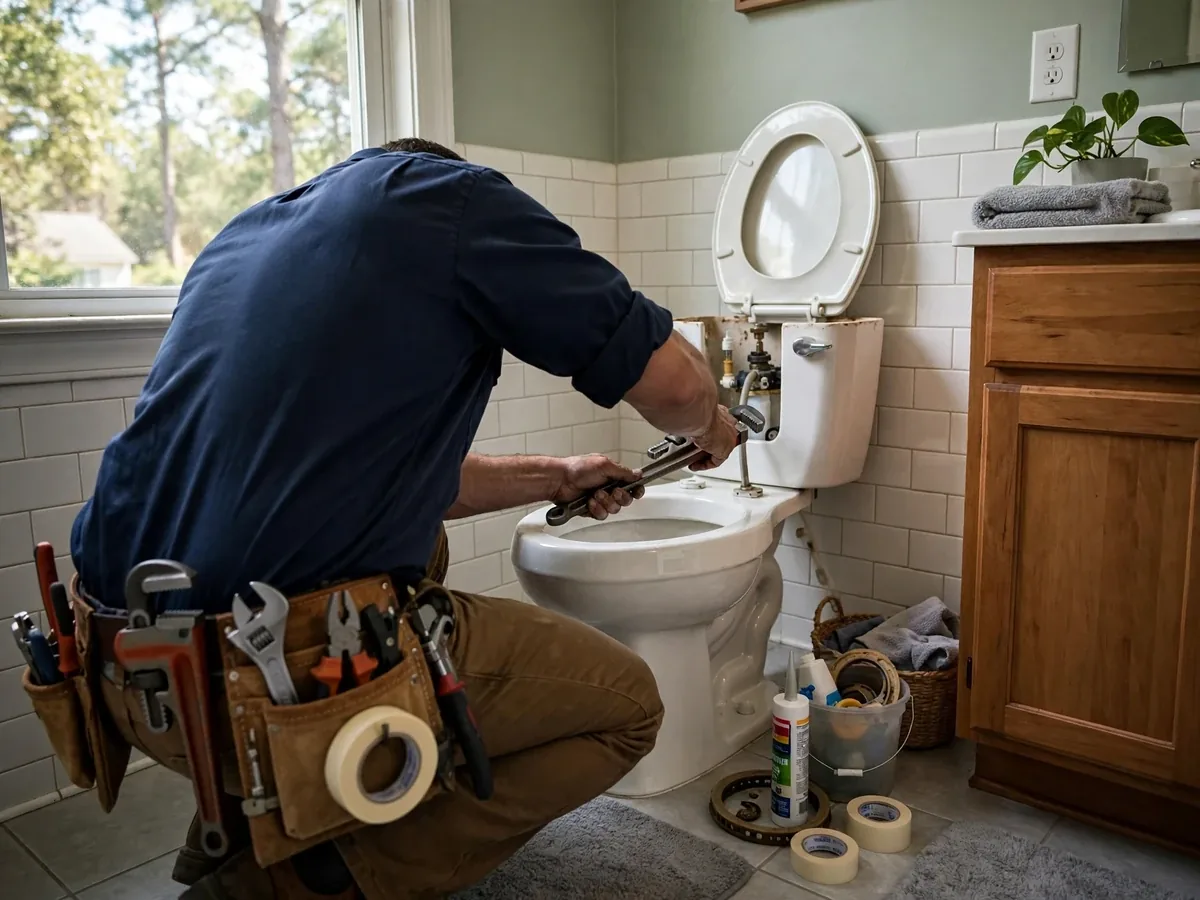
Start here: where is the water actually coming from?.
Water at the base of a toilet comes from one of four places: a failed wax ring or flange seal, a loose or broken closet bolt that lets the bowl rock, a leaking supply line or shutoff valve, or condensation dripping off a cold tank. Each looks nearly identical on the floor, so the first job is a short test to sort them out.
Dry the floor and the toilet with a towel. Wrap a few sheets of toilet paper around the base and the supply connection, flush, and watch where the paper turns wet first. That one test usually points to the right culprit in five minutes.
Reading the clues around the bowl.
A leak at the very bottom edge that shows up only after a flush is the classic wax ring failure. The ring sits between the bowl horn and the closet flange, and when it fails, the water from the flush squeezes out sideways. A leak that is constant, even when no one flushes, usually comes from the supply side.
A toilet that wobbles when you sit down is a warning sign even without visible water. Rocking breaks the wax seal over time, and it often means a closet bolt has snapped or the flange has come loose from the floor.
Signs a toilet is leaking at the base.
- Wet floor tile or vinyl that returns after you dry it.
- Toilet rocks side to side or twists on the floor.
- Caulk at the base is stained, soft or lifting.
- Sewer smell near the toilet, especially after a flush.
- Soft or discolored flooring around the bowl.
- Water stains on the ceiling below, if the bathroom is upstairs.
- Rust or mineral crust around the shutoff valve.
Tank sweat is the one that fools people.
Cold water in a tank on a warm, humid day makes the porcelain sweat. Drips run down the outside and puddle at the base, and people swear the toilet is leaking. The telltale is that the water appears on a hot day, the tank feels cold and wet to the touch, and the floor is dry again by morning.
Put a few drops of food coloring in the tank. If the bowl water stays clear and the floor still gets wet, it is condensation. If color shows at the base after a flush, you have a real leak. Sweat is a nuisance, and an anti-sweat tank liner or a mixing valve that warms the incoming water are the usual cures.
Wax ring, flange and bolts: the parts that fail.
The wax ring is a donut of wax, sometimes with a plastic horn, that seals the toilet outlet to the drain flange. It lasts for years when the toilet stays still. A moving toilet, a settled floor or a crooked ring lets water and sewer gas through.
The flange is the ring that the toilet bolts to, set on top of the floor and connected to the drain pipe. Plastic flanges crack, and old metal ones corrode. If the flange sits below the finished floor level, even a fresh ring may not seal well, and a plumber will use a flange extender or spacer ring to bring the surface up.
Closet bolts hold the bowl to the flange. Overtightening cracks the porcelain, and undertightening lets the bowl rock. A plumber snugs them evenly and stops once the toilet no longer moves.
What a plumber does on a base leak call.
What the repair looks like.
- 1.
Shut off and drain.
The supply valve is closed, the tank is flushed, and the leftover water is sponged out of the bowl and tank.
- 2.
Lift the toilet.
The supply line and closet bolts come off, and the bowl is lifted straight up and set on a drop cloth.
- 3.
Inspect the flange and floor.
The old ring is scraped off, the flange is checked for cracks and height, and the subfloor is probed for soft spots.
- 4.
Reset with a new seal.
A fresh ring goes on, the bowl is set level, the bolts are snugged evenly, and the supply line is reconnected.
- 5.
Test.
Several flushes with a dry paper check at the base before caulking the edge.
A toilet repair visit also catches quieter problems, such as a failing fill valve or a supply stop that no longer closes.
When the leak is not the toilet at all.
Sometimes the water never touched the bowl. A pinhole in a copper supply line, a weeping shutoff valve, or a drain leak from a tub in the same bathroom can travel along a joist and surface next to the toilet. If the ring is new and the floor still gets wet, look elsewhere.
Moisture meters and pressure tests let a plumber separate a seal problem from a hidden line, and leak detection is the fallback when a bathroom keeps getting wet.
Toilet rocking or puddling?.
Dispatch can send a licensed plumber to reset the seal and check the floor under it.
Floor damage and why not to wait.
A slow leak feeds the subfloor with every flush. Plywood swells, grout stains, vinyl peels, and in an upstairs bathroom the ceiling below shows a brown ring. A soft spot near the flange means the repair now includes carpentry.
If you have confirmed a leak and cannot fix it right away, shut the supply valve and avoid flushing. Do not use the toilet while the base is rocking or wet. If water is near an outlet or a power strip in the bathroom, stay away from it and switch off power only if you can do it safely from a dry spot.
| Cause. | Typical sign. | Common fix. |
|---|---|---|
| Failed wax ring. | Wet base after flushing. | Reset toilet with a new ring. |
| Broken closet bolt. | Toilet rocks. | Replace bolts, reset bowl. |
| Cracked flange. | Rocking and persistent leak. | Repair or replace flange. |
| Supply line or stop. | Constant drip at the wall side. | Replace line or valve. |
| Condensation. | Wet only in humid weather. | Tank liner or mixing valve. |
| Cracked bowl. | Leak from the porcelain. | Replace the toilet. |
DIY or call a plumber?.
Replacing a wax ring is a task many handy people do. It takes a helper to lift a toilet that can weigh more than 60 pounds, and a willingness to deal with whatever the flange looks like underneath. The risks are a cracked bowl from overtightening and a flange problem you only find once the toilet is off.
Call a plumber if the floor is soft, if the flange is damaged, if the toilet sits on a hard-to-reach slab, or if the leak returns after a reset. Another reason to call is a sewer smell that does not go away, since a poor seal can let gas into the room.
What affects the price of a toilet base repair.
A simple reset with a new ring is among the lighter jobs a plumber does. The price climbs with a damaged flange, a rotted subfloor, tile that must be re-grouted, or a cracked bowl that needs replacement. A cramped bathroom takes longer.
A plumber should explain what they find before work goes ahead. If the toilet is old, replacement may make more sense than resealing a worn bowl and tank.
Local note
Claremont toilets, sewer laterals and what you flush.
The City of Claremont owns and operates the sanitary sewer, and its sewer page makes the property owner responsible for the private lateral that runs from the house to the City main, usually in the middle of the street. The City does not respond to problems inside a private lateral.
That matters for a base leak because a toilet that gurgles, backs up or smells at the floor may point past the flange to the lateral. The City advises verifying with a plumber that the problem is not the lateral before calling it.
The City also asks residents to flush only toilet paper, with no wipes, paper towels or feminine products, because blockages cost more in older pipes. For backups, the Community Services Department is at (909) 399-5431, and after hours the Police Department non-emergency line is (909) 626-1296.
Neighboring towns, same problem.
Homes in La Verne and Pomona see the same wax ring failures, loose bolts and supply line leaks. What changes is who maintains the sewer, so confirm that with your own city if a backup is involved.
Code reference.
Closet flange and wax ring work follows the California Plumbing Code, built on the Uniform Plumbing Code (UPC). If the floor under the toilet feels soft, stop using it and call a plumber.
Questions about toilet base leaks.
.
It is urgent but rarely life-threatening. Close the supply valve, stop flushing, and call a plumber, since every flush pushes more water into the subfloor. If the leak is a clear gush or sewage is backing up, treat it as an emergency and call right away.
.
A ring can last for decades if the toilet never moves and the flange is sound. It usually fails because the toilet rocks, the floor settles, or the ring was set crooked. If you have to reset the toilet for any reason, install a new ring each time.
.
A leak that appears only after a flush usually means the seal between bowl and flange is failing, because the flush sends a rush of water through it. A constant drip at the wall side, regardless of flushing, points to the supply line or shutoff valve instead.
.
Stop using the toilet and check other drains. If several back up, the problem may be in the private lateral, and the City of Claremont says to verify that with a plumber before calling it. City contact numbers are in the local note above.