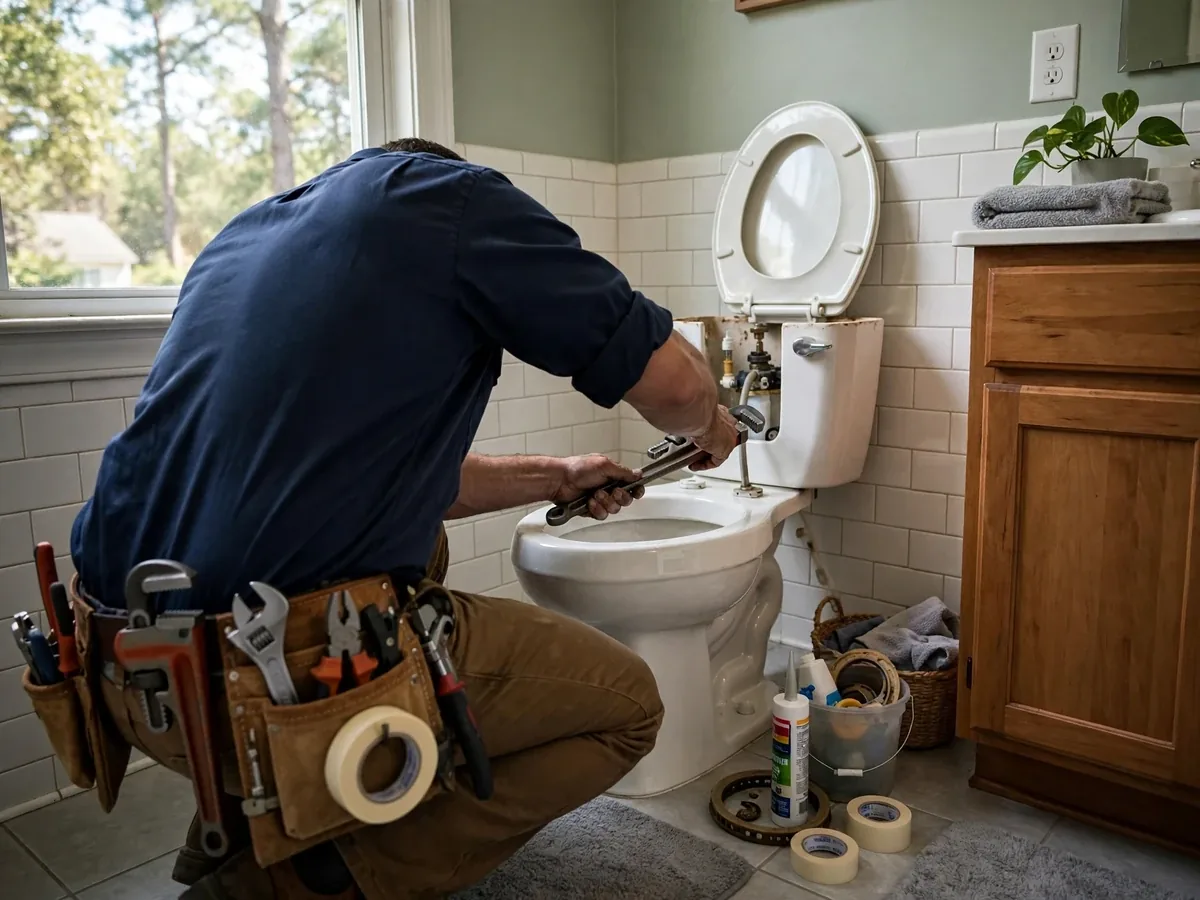
Can you install a toilet yourself?.
Yes, for a straight replacement, most handy homeowners can. You shut off the water, drain the old toilet, unbolt it from the floor, set a new wax ring, lower the new bowl on the closet bolts, tighten, connect the supply and test. The whole job often takes a couple of hours once the old toilet is out.
The risks are in what you find after lifting the old bowl. A rotted floor, a cracked flange or a seized shutoff valve can turn a simple swap into a repair. Knowing that ahead of time is most of the skill.
Before you buy: measure the rough-in.
Toilets are not all interchangeable. The rough-in is the distance from the wall behind the toilet to the center of the drain flange. The most common is 12 inches, but 10 and 14 inch versions exist, and a toilet made for one will not sit right on another.
Measure from the finished wall, not the baseboard, to the center of the closet bolts. Then check the bowl shape. Round bowls save space, elongated bowls are more comfortable and need more room. Confirm the height too, since a taller seat is easier on knees but changes the look.
- Rough-in distance, measured to the bolt centers.
- Round versus elongated bowl and available clearance.
- Flush type and whether the model suits your water pressure.
Tools and parts to gather.
Have everything ready before you shut off the water.
- New toilet with seat, tank bolts and closet bolts.
- New wax ring, or a waxless seal if you prefer.
- New braided supply line.
- Adjustable wrench, screwdriver and a putty knife.
- Old towels, a bucket and a sponge.
- Shims for an uneven floor.
The swap, step by step.
Replacing a toilet.
- 1.
Shut off the water.
Turn the angle stop clockwise, flush to empty the tank, then sponge out what is left. Disconnect the supply line.
- 2.
Remove the old toilet.
Pop off the bolt caps, take off the nuts, then rock the bowl gently to break the seal. Lift straight up and set it on a towel. Mind your back, since a full bowl is heavy.
- 3.
Scrape and inspect.
Remove old wax from the flange. Look for cracks, rust or a loose ring, and stuff a rag in the pipe so sewer gas stays out.
- 4.
Set the new wax ring.
Place the ring on the flange or on the toilet horn, according to the maker's directions. Insert fresh closet bolts into the flange slots.
- 5.
Lower the bowl.
Line the bolt holes up, press straight down, then twist slightly to seat the ring. Do not lift it back up once it is set.
- 6.
Tighten and attach the tank.
Add washers and nuts, tightening a little at a time and alternating sides. Mount the tank to the bowl if it is a two-piece.
- 7.
Connect water and test.
Attach the supply line, open the angle stop slowly, let the tank fill, then flush several times and watch the base for seepage.
Wax ring or flange: where it goes wrong.
The wax ring seals the gap between the toilet horn and the flange. If it is crushed, misplaced or too thin for the gap, you get a slow leak that rots the floor. The flange is the part that bolts to the floor, and it should sit level with or slightly above the finished floor.
When you install new tile or flooring, the floor rises and the flange can end up below it. That leaves a gap the ordinary wax ring cannot fill, so a thicker ring or a flange spacer is needed. A cracked or rusted flange is a repair, not a shim job.
The supply line and angle stop.
The angle stop is the small valve in the wall or floor that feeds the toilet. Old ones can seize, drip or snap off when turned. If the valve does not shut off fully, replace it before the swap, because working with live water at the connection is how floors get flooded.
Use a braided stainless supply line sized for the distance and hand-tighten, then give a gentle quarter turn with a wrench. Overtightening cracks plastic nuts. If you want help with this, our toilet repair service covers angle stops and supply connections.
Flange cracked or valve stuck?.
Dispatch can send a licensed plumber to finish the swap or repair the parts under the toilet.
Claremont hard water and your new toilet.
Local note
What Claremont's water means for fill valves.
Golden State Water Company's 2026 Annual Water Quality Report for the Claremont Water System, based on 2025 data, lists hardness from 97 to 330 milligrams per liter, averaging 190. In grains per gallon, the range is 5.7 to 19, with an average of 11.
Hard water leaves mineral scale on the small parts of a toilet, such as the fill valve, flapper and supply screen. Those parts are cheap to replace, but scale shortens their life. The utility's 24-hour customer line is 1-800-999-4033 if you want to know what your tap carries.
Common mistakes and how to avoid them.
| Problem. | Likely cause. | What to do. |
|---|---|---|
| Toilet rocks after install. | Uneven floor or flange height. | Shim, then caulk the base. |
| Water seeps from the base. | Wax ring not seated or too thin. | Pull the toilet and reset it. |
| Tank keeps running. | Fill valve height or flapper not sealing. | Adjust or replace the parts. |
| Slow flush. | Partial clog or weak flush design. | Test with the old toilet in mind. |
| Sewer smell at the bowl. | Poor seal or cracked flange. | Reset ring, inspect the flange. |
| Supply line drips. | Loose or damaged nut. | Tighten a quarter turn, replace line. |
Signs the job is bigger than a swap.
Stop and call a professional when the floor around the flange feels soft, spongy or stained. Rot there means water has been leaking for a while, and a new toilet will not fix it. The same goes for a flange broken into pieces, a drain pipe that has moved, or a toilet that sits over a cast iron stack with corroded connections.
- Soft or discolored subfloor near the base.
- Flange that is cracked, bent or well below the floor.
- Angle stop that will not close fully.
- A toilet that has leaked or gurgled for months before the swap.
- Moving the toilet to a new spot.
Moving a toilet means new drain and vent piping. That is plumbing installation work, and it is the job where a professional pays for itself.
Permits and rules.
Replacing a toilet in the same spot is minor, but rules vary and moving fixtures can change things. The City of Claremont says its Building Division should be contacted to confirm requirements for plumbing work. Call them at (909) 399-5477 and describe what you plan to do.
If you hire a contractor, you can look up a license and complaint history through the California Contractors State License Board. Homes in La Verne and Montclair answer to their own city rules, so check with the correct office.
Code and permit note.
A like-for-like toilet swap generally follows the California Plumbing Code, built on the Uniform Plumbing Code (UPC). If you are changing the drain or moving the toilet, ask the Claremont Building Division at (909) 399-5477 first.
DIY toilet install questions.
.
Most replacements take two to three hours for someone doing it the first time. The old toilet comes out in minutes. The slow parts are scraping the flange, setting the new ring and checking for leaks after several flushes.
.
Yes. The wax ring is a one-time seal. Once a toilet is lifted, the wax deforms and will not seal again reliably, so use a new ring or a waxless seal every time you reset or replace a toilet.
.
It is a good idea to replace the supply line, since it is inexpensive and old ones can burst. The angle stop matters if it will not close fully or drips. If it is stuck, a plumber can swap it safely.
.
It can wear small parts. Golden State Water Company reports an average hardness of 190 milligrams per liter, which leaves scale on fill valves, flappers and screens. Those parts are replaceable, so plan to check them every few years.
.
Ask the Claremont Building Division at (909) 399-5477. The city says plumbing work should be confirmed with the division, and the answer depends on what you are doing. A like-for-like swap is different from moving fixtures.
.
The usual cause is a ring that did not seat or a flange set too low. Tightening the nuts harder can crack the porcelain, so lift the toilet and reset the seal instead. If the flange is damaged, it needs repair.